

The most famous Greek goddess statues include the Venus de Milo, the Winged Victory of Samothrace, Athena Parthenos, the Aphrodite of Knidos, and the Demeter of Knidos. Together, these sculptures shaped how later generations imagined beauty, wisdom, victory, nature, justice, and divine authority.
However, these works did not all survive in the same form. Some are original ancient Greek sculptures. Others are Roman marble versions of lost Greek bronzes. A few, including Athena Parthenos and the Aphrodite of Knidos, are famous even though the original statues no longer exist. This guide explains those differences so that you can understand what each surviving statue actually represents.
| Statue | Goddess | Approximate Date | Material | What Survives | Current Location |
|---|---|---|---|---|---|
| Venus de Milo | Aphrodite | c. 150–130 BCE | Parian marble | Hellenistic Greek original | Louvre Museum, Paris |
| Winged Victory of Samothrace | Nike | c. 200–175 BCE | Parian and Lartos marble | Hellenistic Greek original | Louvre Museum, Paris |
| Athena Parthenos | Athena | 5th century BCE | Gold and ivory over a wooden core | Original lost; known through ancient copies | Originally in the Parthenon, Athens |
| Aphrodite of Knidos | Aphrodite | Mid-4th century BCE | Marble | Original lost; Roman versions survive | Copies in several museums |
| Demeter of Knidos | Demeter | c. 350–330 BCE | Marble | Ancient Greek original | British Museum, London |
| Artemis and the Stag | Artemis | c. 1st century BCE–1st century CE | Bronze | Ancient bronze statue | The Metropolitan Museum of Art, New York |
| Diana of Versailles | Artemis | After a Greek prototype of c. 330 BCE | Marble | Ancient marble version after a lost bronze | Louvre Museum, Paris |
| Pallas of Velletri | Athena | 1st century CE | Marble | Roman copy after a Greek bronze | Louvre Museum, Paris |
| Capitoline Venus | Aphrodite | Mid-2nd century CE | Marble | Roman version of a Greek statue type | Capitoline Museums, Rome |
| Medici Venus | Aphrodite | Late 2nd–early 1st century BCE | Parian marble | Hellenistic sculpture | Uffizi Galleries, Florence |
| Themis of Rhamnous | Themis | c. 300 BCE | Marble | Hellenistic Greek original | National Archaeological Museum, Athens |
| Hera Campana | Hera, traditionally identified | 2nd century CE | Marble | Roman statue after a possible Hellenistic model | Louvre Museum, Paris |

The Venus de Milo is probably the world’s best-known statue of a Greek goddess. It was discovered on the island of Milos in 1820 and entered the Louvre the following year. Although its familiar name uses the Roman “Venus,” the figure is generally identified as Aphrodite, the Greek goddess of love and beauty.
The statue was carved during the Hellenistic period, around 150–130 BCE. Its composition combines a calm upper body with a twisting stance and deeply folded drapery around the hips. The missing arms have encouraged many reconstructions. One proposal shows Aphrodite holding the apple awarded to her by Paris; another suggests that she may have held a shield. No reconstruction has been proven.
Unlike many famous classical statues known only through Roman copies, the Venus de Milo is an ancient Greek original. The Louvre explains that the statue was found in separate fragments and that its original pose remains uncertain. This combination of survival and mystery has helped make it a lasting symbol of classical beauty.

The Winged Victory of Samothrace represents Nike, the Greek goddess who personified victory. Created during the Hellenistic period, the statue originally stood in the Sanctuary of the Great Gods on the island of Samothrace.
Nike appears to have just landed on the prow of a ship. Her wings extend behind her while the wind presses her thin tunic against her body. At the same time, heavy folds of fabric sweep outward around her legs. This contrast between clinging and billowing drapery gives the sculpture its extraordinary sense of movement.
The statue’s head and arms are missing, but its pose remains powerful. Fragments of the right hand indicate that the hand was open rather than holding an object. The ship-shaped base also helps identify the monument as a dedication connected with naval victory.
Today, the sculpture stands at the top of the Daru staircase in the Louvre. The museum describes it as a timeless icon of Western art and explains how the statue was designed to be viewed from a three-quarter angle. See the Louvre’s account of the Winged Victory.

Athena Parthenos was the colossal gold-and-ivory statue created under the direction of Pheidias for the Parthenon in Athens. Athena was the goddess of wisdom, strategic warfare, skilled craftsmanship, and civic protection. In this form, she stood as the divine guardian of the city that carried her name.
The statue once occupied the main chamber of the Parthenon. It had a wooden core covered with ivory for the visible skin and gold for the clothing and armor. Ancient descriptions and smaller surviving copies indicate that Athena wore a helmet and aegis, carried a shield, and held a figure of Nike in one hand.
The original Athena Parthenos is lost. Therefore, photographs of a complete “Athena Parthenos” usually show a reconstruction or an ancient reduced copy, not the work made by Pheidias. The Varvakeion Athena in the National Archaeological Museum of Athens is one of the most useful ancient copies for understanding the original design.
The Acropolis Museum’s Parthenon Gallery confirms that the temple’s main chamber housed Pheidias’s gold-and-ivory statue. This distinction between lost original and surviving copy should always be made clear when discussing or reproducing Athena Parthenos.

Praxiteles created the Aphrodite of Knidos in the middle of the 4th century BCE for a sanctuary at Knidos. The goddess appears beside a water vessel, placing down or lifting her clothing as she prepares for a ritual bath. With her other hand, she covers her pubis.
The statue became famous in antiquity because it presented the goddess nude at monumental scale. Its pose did more than conceal the body: the gesture also directed attention toward Aphrodite’s divine beauty and sexual power. The composition became one of the most influential female statue types in Western art.
Praxiteles’s original marble no longer survives. Its appearance is known through ancient texts and numerous Roman versions. These copies vary, so no surviving statue should be presented as the untouched original Aphrodite of Knidos.
The Getty’s study of Aphrodite explains the importance of the Knidian statue and its many later versions. A Roman marble example of the same type can also be seen in the Uffizi Galleries’ collection.
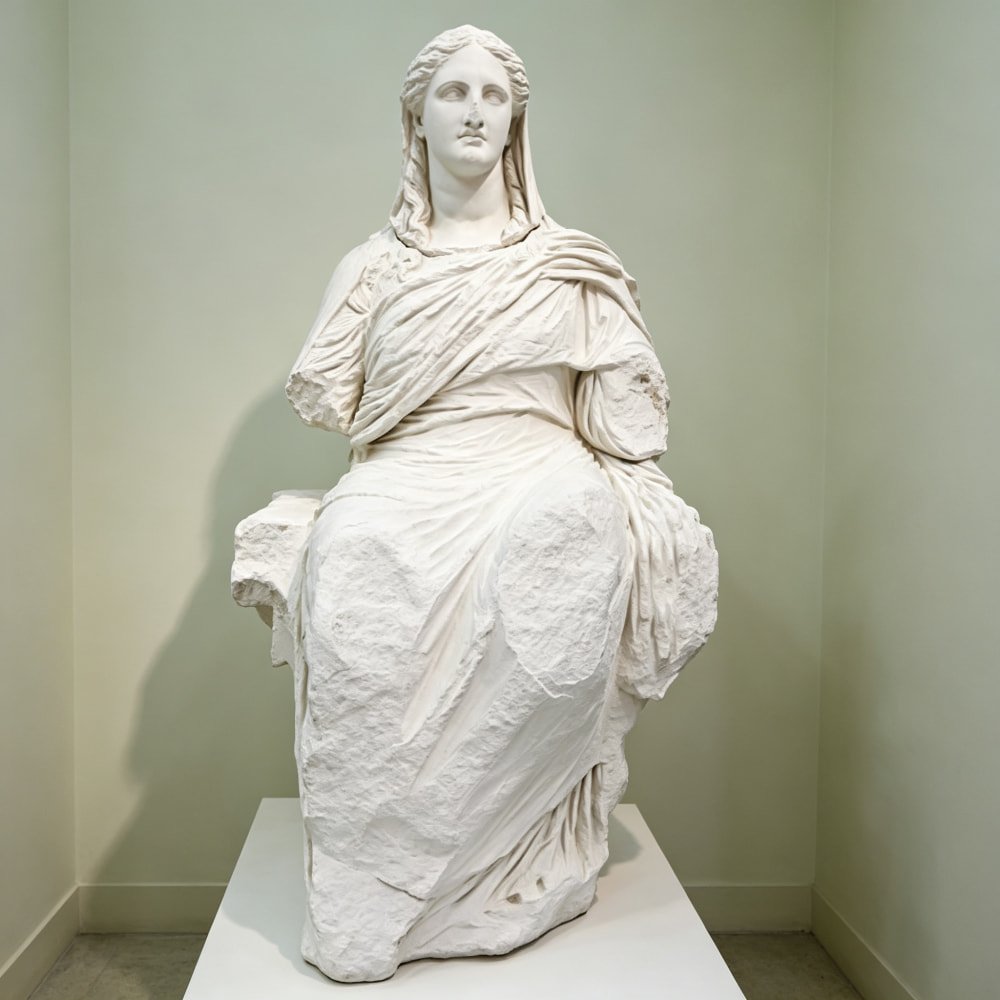
The Demeter of Knidos presents the goddess of agriculture, grain, fertility, and the seasonal cycle as a mature, seated woman. It was carved around 350–330 BCE and displayed in the Sanctuary of Demeter at Knidos, in what is now southwestern Turkey.
Demeter wears layered drapery that falls in long, carefully organized folds. Her composed posture conveys authority, while her expression has often been interpreted as quiet sorrow. That mood connects naturally with the myth of her daughter Persephone, whose annual departure for the underworld explained the changing seasons.
The statue’s lower arms and hands are missing. They may once have held a torch or a libation bowl, both objects associated with Demeter’s worship. Unlike the lost Aphrodite of Knidos, this figure is an original ancient Greek marble sculpture.
The statue is now displayed in the British Museum. Its official collection record identifies the findspot, material, dimensions, and likely attributes. See the British Museum record for the Demeter of Knidos.
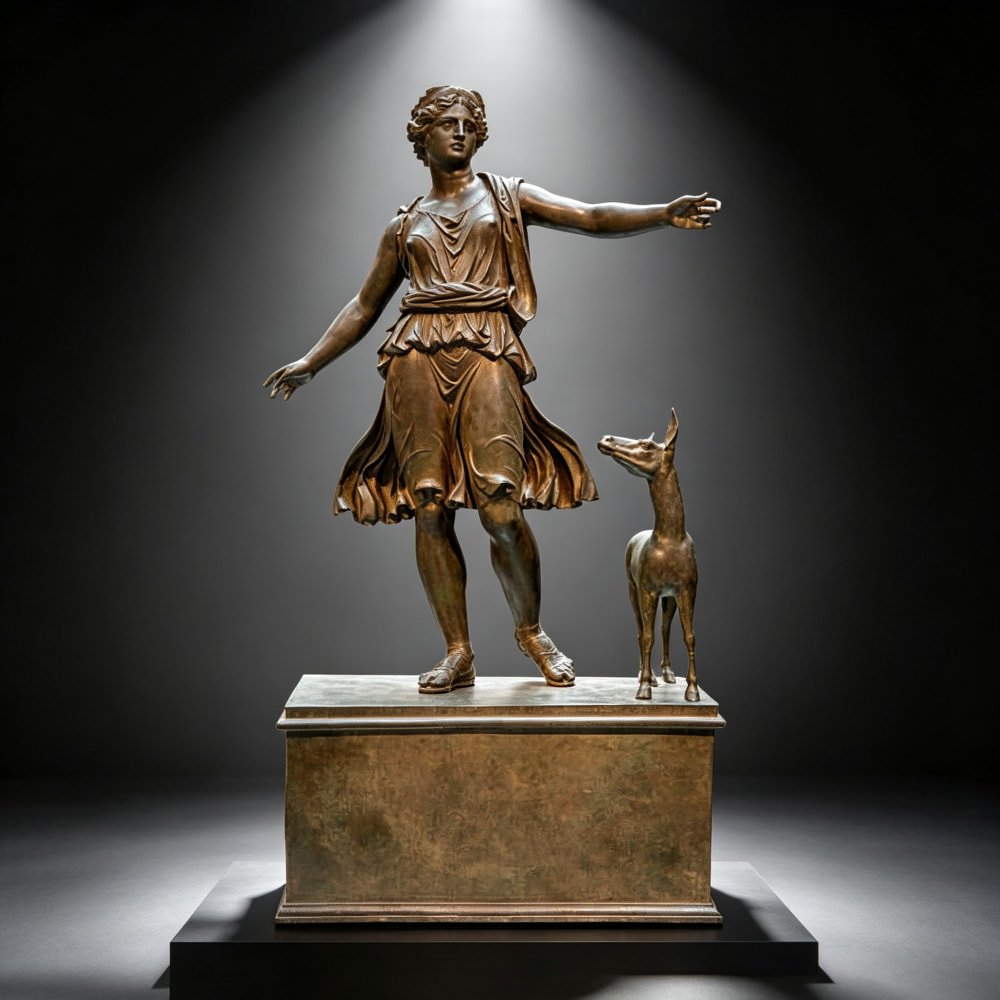
This bronze statue shows Artemis, goddess of the hunt, wilderness, and wild animals, standing beside a deer. She wears a short chiton suited to movement, a diadem, and carefully detailed sandals. Her missing left hand probably held a bow.
The work is especially important because large ancient bronze statues survive far less often than marble sculptures. Bronze could be melted and reused, so many celebrated Greek bronzes disappeared. This statue preserves the lighter supports, extended forms, and fine surface detail that bronze casting made possible.
The figure was cast in several sections using the lost-wax method and then joined. Its exact date lies near the transition between the late Hellenistic and early Roman periods, so it is more accurate to describe it as an ancient bronze than to force it into a simple “Greek original versus Roman copy” category.
Artemis can be recognized by her hunting dress, bow, and deer. The Metropolitan Museum of Art provides a detailed description of the statue, its construction, and its surviving attributes.
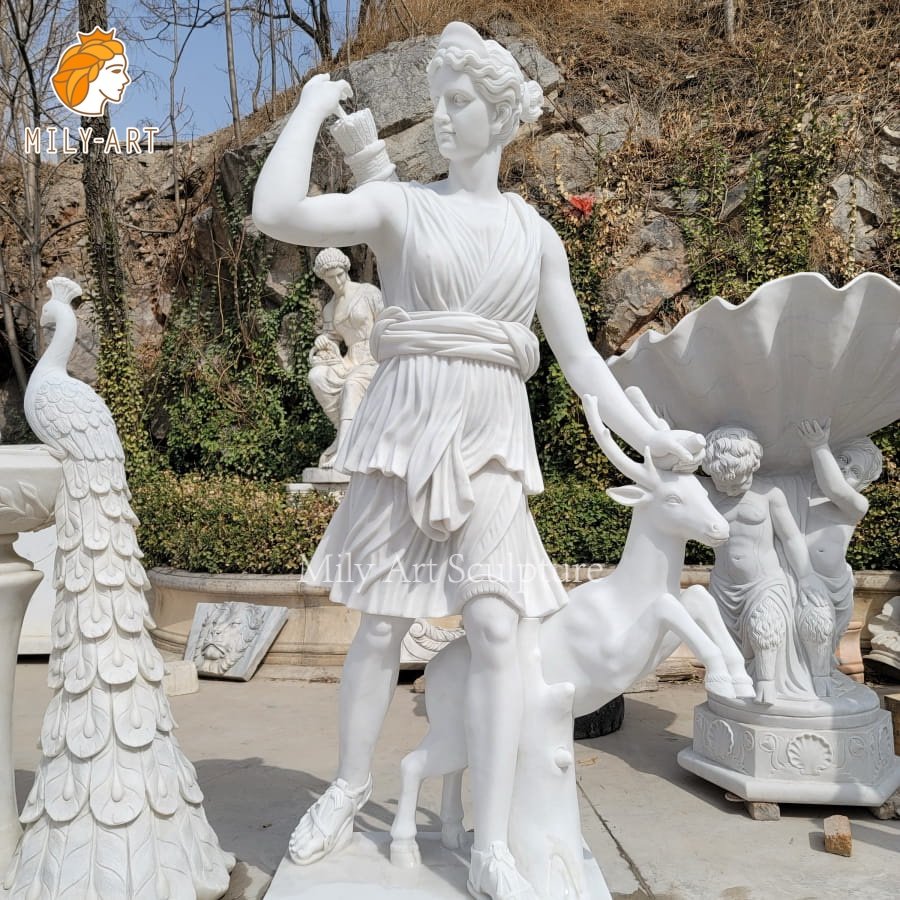
Known as the Diana of Versailles, this dynamic marble figure represents Artemis, called Diana by the Romans. The goddess strides forward while reaching toward the quiver on her back. A deer stands beside her, reinforcing her identity as the huntress of the wilderness.
The statue is an ancient marble version of a lost Greek bronze prototype usually dated to around 330 BCE. Its open stance and active movement reveal the advantages of the original bronze composition, while the marble version uses the deer and tree-like support to stabilize the figure.
The work became part of the French royal collection and once decorated the Palace of Versailles, which explains its modern name. It is now displayed in the Louvre’s Salle des Caryatides.
The Louvre describes the Diana of Versailles as a Roman marble rendering of a Greek bronze model. That relationship is important for buyers and art lovers: a modern marble reproduction may ultimately descend from a Roman marble version of a Greek design that was originally made in bronze.
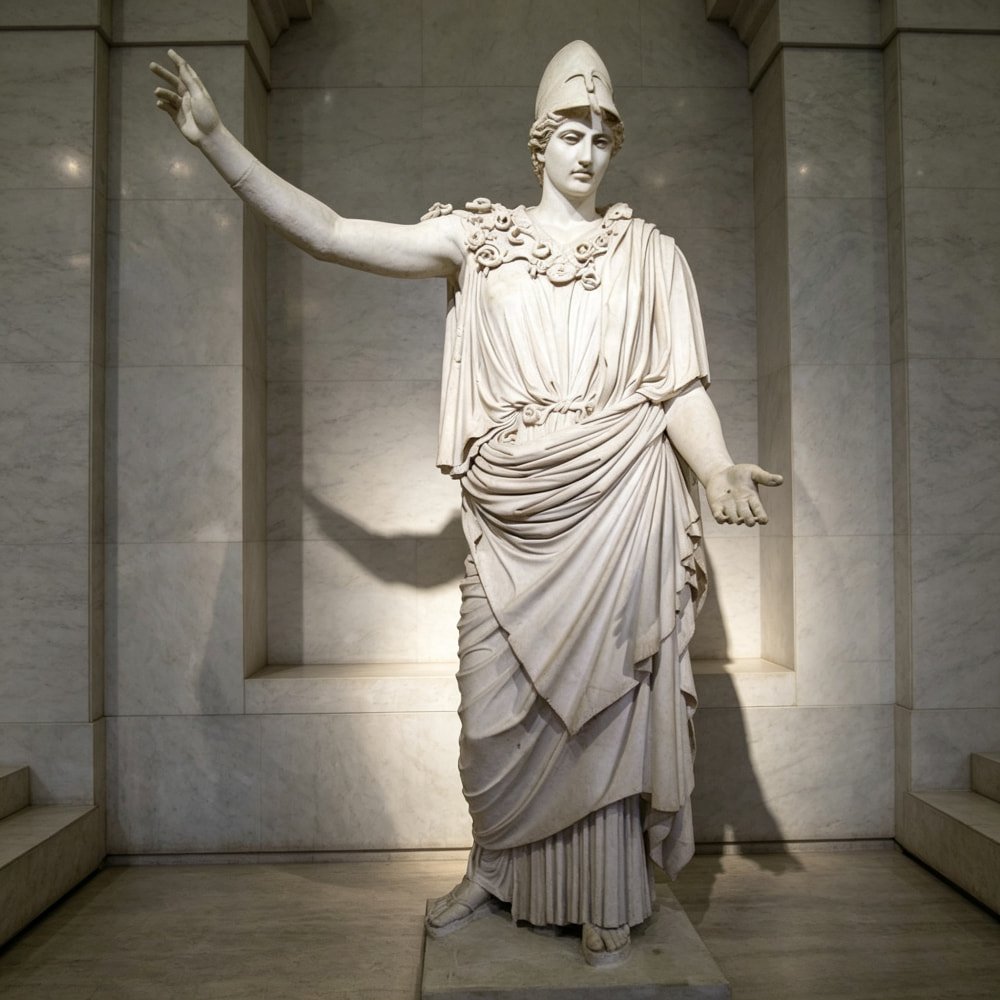
The Pallas of Velletri is a monumental image of Athena. Standing more than three meters high, the goddess wears a helmet, peplos, aegis, and a Gorgon head on her chest. These attributes identify her immediately as a protector associated with wisdom and disciplined warfare.
The surviving marble was made in the Roman Imperial period, probably in the 1st century CE. It is understood as a copy of a lost Greek bronze traditionally connected with the sculptor Kresilas and dated to the late 5th century BCE.
Although the hands and parts of the feet were restored after the statue’s discovery, much of the ancient figure survives. Traces of red pigment on the eyes and lips are a reminder that classical statues were not always plain white. Many ancient sculptures originally included painted details and attached accessories.
Discovered at Velletri in 1797, the statue is now in the Louvre. The museum’s Pallas of Velletri collection record documents its scale, materials, restoration, surviving color, and relationship to the lost Greek bronze.
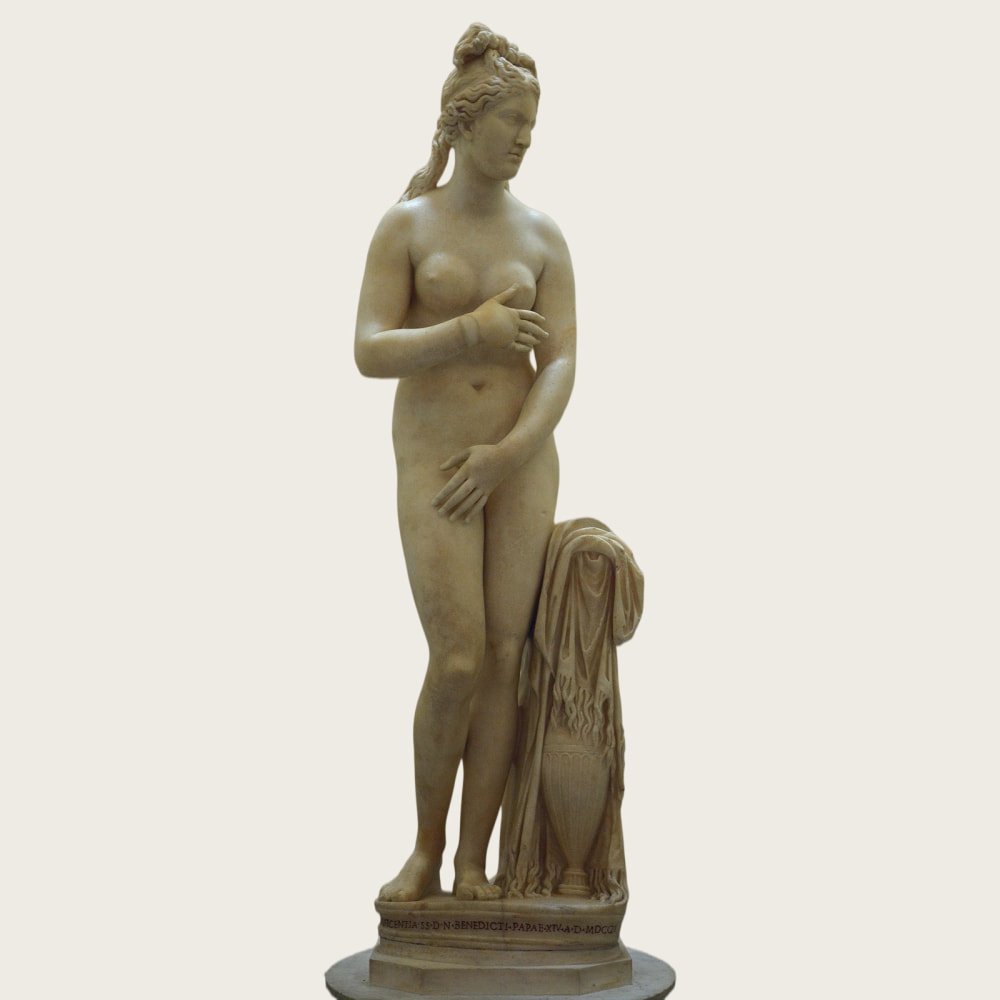
The Capitoline Venus shows Aphrodite surprised during or after bathing. She turns slightly and brings both arms across her nude body in a modest, protective gesture. A vessel and drapery beside her establish the bathing context.
The statue was created in the Roman period, probably in the mid-2nd century CE, but its design belongs to the long tradition that developed from the Aphrodite of Knidos. It is therefore best described as a Roman version of a Greek Aphrodite type, not as a Classical Greek original.
The work was discovered in Rome between 1667 and 1670. It had been carefully hidden inside an ancient wall, perhaps to protect it during a period of danger. Its excellent preservation helped it become one of the most admired images of Venus in European collections.
The statue now stands in a room designed around it at the Capitoline Museums. The museum’s Cabinet of Venus explains the discovery, bathing symbolism, and connection with Praxiteles’s famous Knidian prototype.
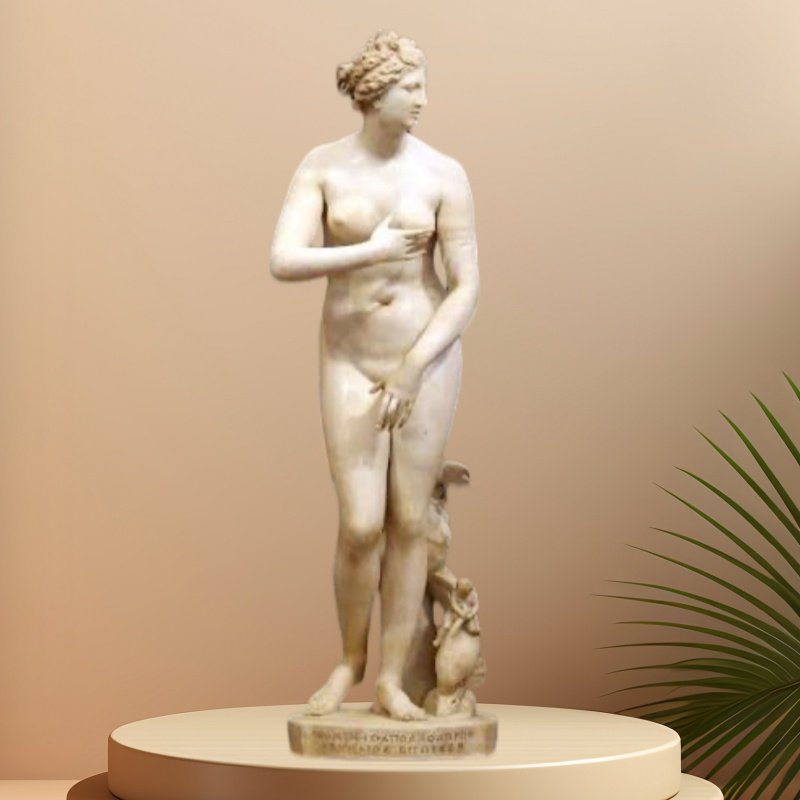
The Medici Venus is another celebrated “pudica,” or modest Venus, in which the goddess instinctively covers her body. Created in the late 2nd or early 1st century BCE, the figure adapts the Knidian tradition into a more delicate and self-conscious pose.
The statue is made primarily from fine Parian marble. Its ears were pierced for metal jewelry, and conservation work revealed traces of gilding in the hair, cinnabar on the lips, and Egyptian blue near the dolphin. These details challenge the modern idea that Greek and Roman sculpture was intended to appear completely white.
An ancient Greek signature appears on the base, but research has shown that the signed base did not originally belong to the statue. The figure should therefore not be confidently attributed to the named sculptor on that inscription.
The Medici Venus became one of the most admired classical sculptures in Europe before the rise of the Venus de Milo. It remains in the Uffizi Galleries in Florence. The Uffizi’s official record provides detailed information about its material, restoration, pigment, and complicated base.
Themis personified divine law, order, and the customs that governed relations between gods and human beings. The Themis of Rhamnous, dated to around 300 BCE, is one of the most important surviving sculptural representations of this goddess.
The statue was found at Rhamnous in Attica and preserves a dignified, heavily draped figure. Its authority comes from posture and clothing rather than armor or nudity. The surviving ancient base helped identify the subject and historical setting.
This statue should not be confused with the much later image of Lady Justice wearing a blindfold and carrying scales. Those familiar attributes developed through later artistic traditions. Ancient Themis could be represented without the complete set of symbols now associated with modern courts.
The statue is displayed in the National Archaeological Museum in Athens. The museum highlights the Themis of Rhamnous among its major Hellenistic sculptures in its official collection guide.
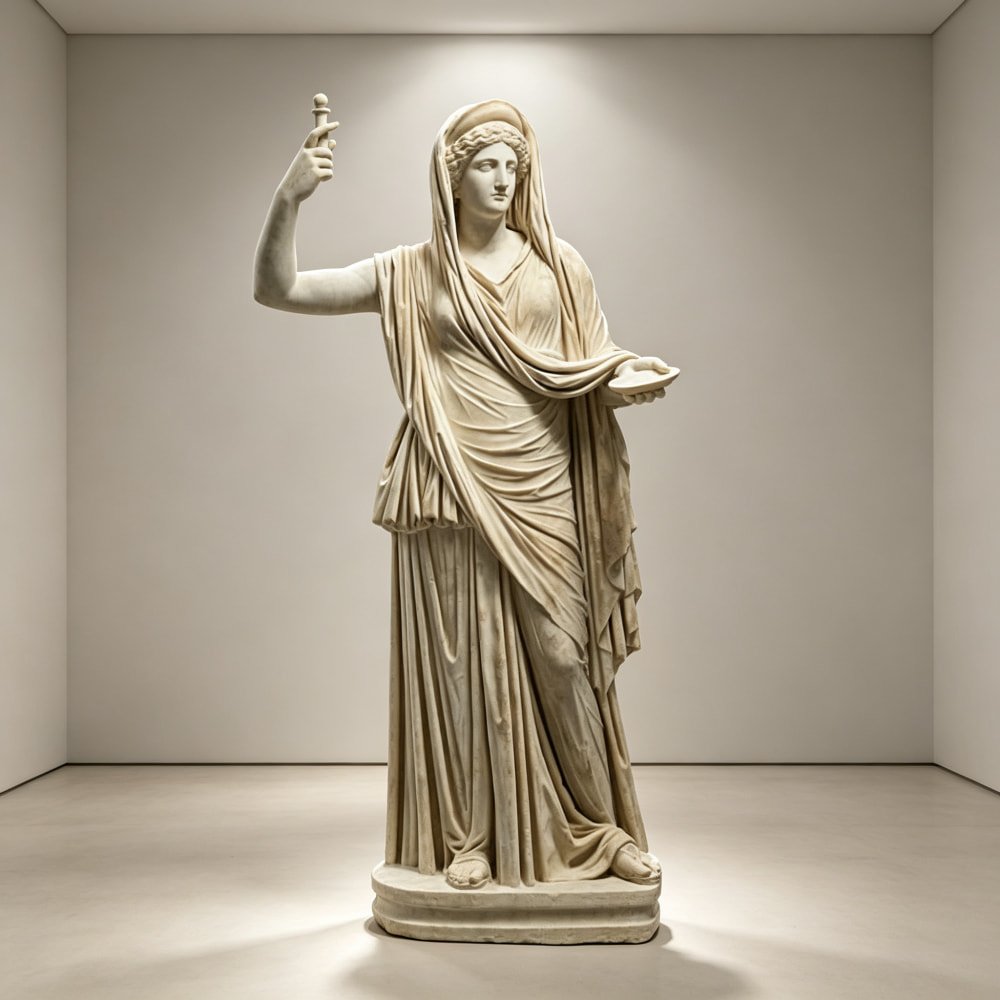
Hera was the queen of the Olympian gods and the goddess of marriage, queenship, and legitimate family order. The statue known as Hera Campana presents a majestic, fully draped woman wearing a diadem and veil—features appropriate to Hera’s royal status.
The surviving marble dates to the Roman Imperial period, probably the first half of the 2nd century CE. It may reproduce or adapt a Hellenistic model from the 3rd century BCE. The arms and parts of the face were restored in modern times.
Even the statue’s identity requires care. The Louvre calls it “Hera Campana,” but its collection record also preserves scholarly uncertainty about whether the figure is definitely Hera. This is common in ancient sculpture: when inscriptions or original attributes are missing, names may remain traditional rather than certain.
The statue came from the collection of Giampietro Campana and is now displayed in the Louvre near the Winged Victory. See the museum’s Hera Campana collection record for its date, restoration history, and proposed Greek prototype.
These terms describe different stages in the history of classical sculpture:
Calling every white marble goddess a “Greek original” hides this fascinating history. A high-quality reproduction should identify the precise prototype it follows and explain whether that prototype is an original Greek work, an ancient Roman version, or a scholarly reconstruction.
For a symbol-by-symbol comparison of helmets, bows, wings, grain and other attributes, use our Greek goddess statue identification guide. This article focuses on named artworks, their historical status and where they are held.
A museum original, an ancient Roman copy and a modern workshop reproduction are different objects. Check the museum label or collection record before attributing a date, maker or material. Images of Mily products illustrate modern interpretations and do not show the original museum objects unless explicitly identified.
For a contemporary project, explore our marble Greek statue collection.
The Venus de Milo is probably the most widely recognized statue of a Greek goddess. The Winged Victory of Samothrace is another global icon. Both are displayed at the Louvre, while Athena Parthenos remains famous even though the original statue is lost.
Many sculptures entered European collections under the Roman names of the goddesses. Venus is the Roman counterpart of Aphrodite, and Diana is the Roman counterpart of Artemis. A statue called “Venus” can therefore represent the Greek goddess Aphrodite or a Roman interpretation of her.
No. Some, including the Winged Victory and Demeter of Knidos, are ancient Greek originals. Others are Roman copies or adaptations of lost Greek works. Athena Parthenos and the original Aphrodite of Knidos no longer survive and are known through descriptions, coins, and later copies.
Arms, hands, fingers, wings, and attached attributes project away from the body and break more easily than the main torso. Some statues were also buried, moved, reused, or damaged over many centuries. Missing limbs are therefore common but are not a deliberate feature of Greek sculpture.
Famous Greek goddess statues are more than idealized female figures. Each one carries a distinct identity expressed through posture, clothing, animals, and symbolic objects. Their histories also reveal how Greek designs traveled across the ancient Mediterranean, were copied by Roman sculptors, entered European collections, and continue to inspire artists today.
Understanding whether a work is a Greek original, Roman adaptation, lost masterpiece, or modern replica makes the sculpture more meaningful. Whether you are studying classical art or planning a custom marble reproduction, begin with the goddess, the historical prototype, and the attributes that make her recognizable.
MilyStatue creates hand-carved marble sculptures for gardens, villas, hotels, public spaces, and private collections. If you would like to reproduce one of these Greek goddess statues in a custom size or marble color, contact MilyStatue with your preferred design, dimensions, and installation environment.

 We only use the information provided above to contact you in relation to your inquiry. For further details, read our Privacy Policy.