
To identify a Greek goddess statue, look first at the objects, clothing and companions around the figure. A helmet and aegis suggest Athena; a bow and deer suggest Artemis; wings may suggest Nike. A face, a white-marble surface or an elegant pose alone is not a reliable identification.
This is a practical guide to names and visual clues. For the histories, dates and museum locations of particular works, see 12 famous Greek goddess statues.
| Greek name | Roman counterpart | Useful visual clues | Main association | Check before deciding |
|---|---|---|---|---|
| Athena | Minerva | Helmet, spear, shield, aegis; sometimes an owl | Wisdom, skilled craft and strategic warfare | An armed female figure needs more than a helmet for certain identification. |
| Artemis | Diana | Bow, quiver, deer; often a short hunting tunic | Hunting and the wilderness | Missing or restored accessories can change the reading. |
| Aphrodite | Venus | Bathing or modest pose; drapery, apple or small Eros in some types | Love and beauty | A nude female figure is not always Aphrodite. |
| Nike | Victoria | Wings; sometimes a wreath or palm | Victory | Wings also occur on other figures; examine the whole composition. |
| Hera | Juno | Crown or polos, veil, scepter; peacock in some depictions | Marriage and divine queenship | A crown or veil can also belong to another goddess or mortal. |
| Demeter | Ceres | Grain, sheaves or torches in appropriate contexts | Agriculture and harvest | A cornucopia alone is shared by several personifications. |
| Hebe | Juventas | Pitcher and drinking cup in many later sculptures | Youth and service as cupbearer | A vessel-bearing figure may instead be a nymph or generic fountain design. |
| Hecate | Trivia | Triple-bodied form, torches, keys or dogs in some types | Crossroads and boundaries | Triple form is distinctive, but context and the object record remain important. |
Treat these as clues rather than a checklist that guarantees a name. Attributes can be missing, recarved or combined in a modern design. For ancient works, consult the holding museum’s record; for a reproduction, ask for the design reference.
Athena is commonly represented as an armed guardian. Examine the helmet, shield and chest for an aegis or a Medusa-head motif. Artemis is more often shown as a huntress, with a bow, quiver and animal companion. The Met’s guide to Greek gods and attributes provides historical context for these distinctions.
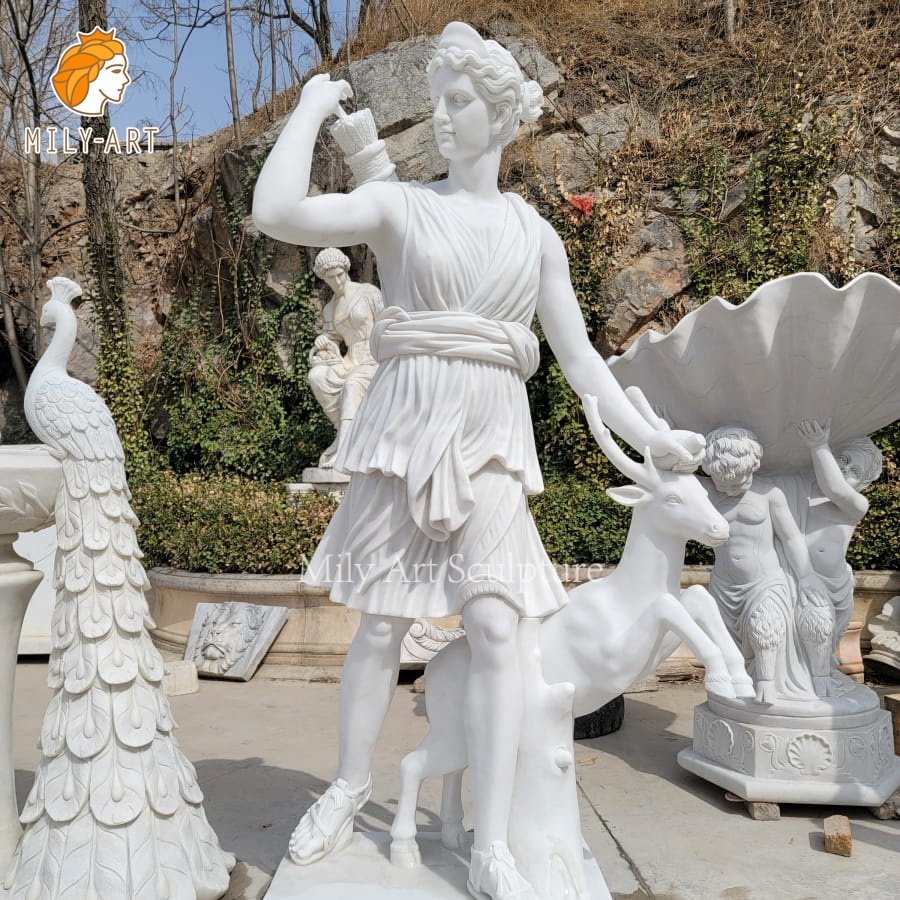
Compare the documented details of our Athena statue and Artemis design when planning a contemporary commission.
Aphrodite appears in several established sculptural types, including bathing and partially draped figures. Nike is associated with wings and the idea of victory, often with a forceful sense of movement. These familiar contrasts help, but they do not identify every fragment or later imitation.

For specific examples, compare Mily’s Venus de Milo interpretation and Winged Victory design. The original artworks and their museum records are discussed in the separate famous goddess artworks guide.
A regal crown and veil may point toward Hera, while grain can support an identification as Demeter. Cup and pitcher imagery is associated with Hebe in many later sculptures. Hecate’s triple-bodied form is a more distinctive clue than any single torch. The important question is how the attributes work together.
Do not identify Demeter solely from a sad expression, Hera from mature features, or Hebe merely from youthfulness. Expressions and body types are workshop choices as well as iconographic conventions.

Museum descriptions and modern catalogs often use Venus for Aphrodite, Diana for Artemis or Minerva for Athena. These correspondences help readers compare traditions; they do not mean every Greek and Roman cult or artwork was identical.
A Roman marble statue can reproduce a Greek sculptural type. A modern marble replica can then reproduce that Roman version. The name identifies the subject, while the collection record establishes the date, material and object history. See our Greek and Roman statue comparison for broader context.
Sometimes, if distinctive attributes survive and the object has a documented context. Otherwise the identification may remain uncertain. A crown or hairstyle alone can be misleading.
No. Nike is an important possibility, but wings occur in other mythological and later decorative subjects. Check the pose, accessories, date and collection record.
No. Modern justice imagery may use scales, sword and blindfold. It should not be labeled as a photograph or exact reconstruction of the ancient marble Themis of Rhamnous without supporting evidence.
Send full-length front and side views, close-ups of attributes, the intended name and any source record. Specify missing accessories that should be reconstructed before approving the design.
Explore our marble Greek statue collection. Confirm the subject, attributes, finished dimensions and installation setting in the written specification. A modern commission can be inspired by classical art while remaining clearly described as a modern work.

 We only use the information provided above to contact you in relation to your inquiry. For further details, read our Privacy Policy.