

I have learned through outdoor sculpture projects that the better solution starts earlier: choose the right material, finish, placement, and maintenance plan.
To protect outdoor metal sculptures, I recommend starting with the site environment, then confirming the metal grade, surface finish, anti-corrosion treatment, drainage, installation details, and cleaning schedule before production. Stainless steel is corrosion-resistant, not maintenance-free, so regular gentle cleaning and early inspection are essential for long-term outdoor display.
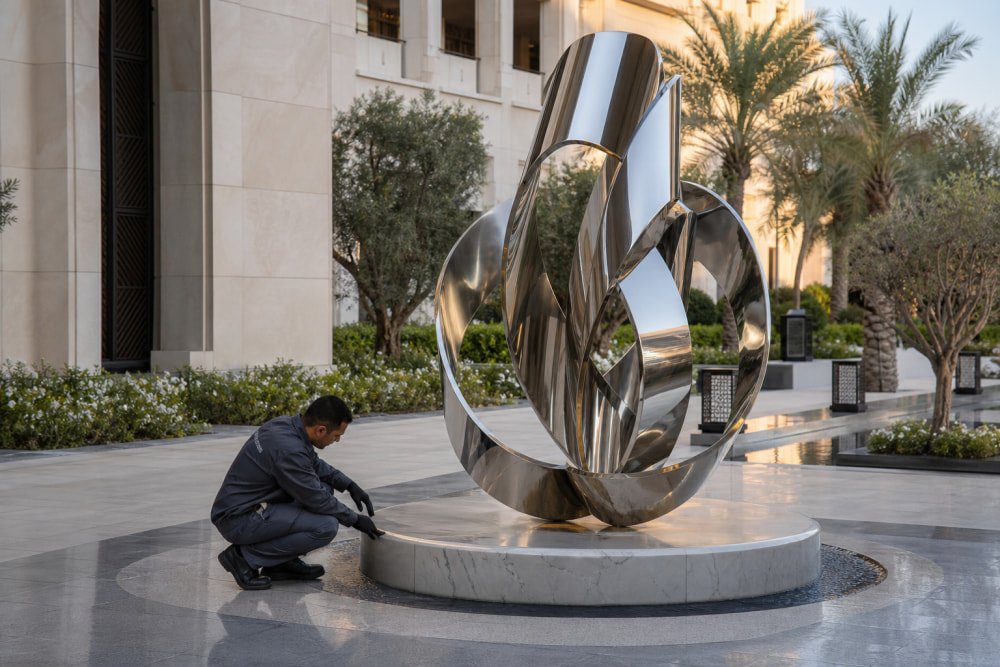
Many people ask me which cleaner they should buy. I usually answer with another question: where will the sculpture stand? A seaside villa, a snowy garden, a city plaza, and a shaded courtyard all create different risks. So let me break this down in a practical way.
Many outdoor metal sculptures are damaged slowly because the site was not studied before purchase. The buyer may choose a beautiful mirror finish, but the sculpture may face salt air, irrigation spray, or pollution every day.
Protection for outdoor metal sculptures should start with the site environment because moisture, salt, pollution, sunlight, snow, and water retention all affect the metal surface1. A sculpture in a coastal garden needs different material, finish, and maintenance planning from one in a dry inland courtyard.
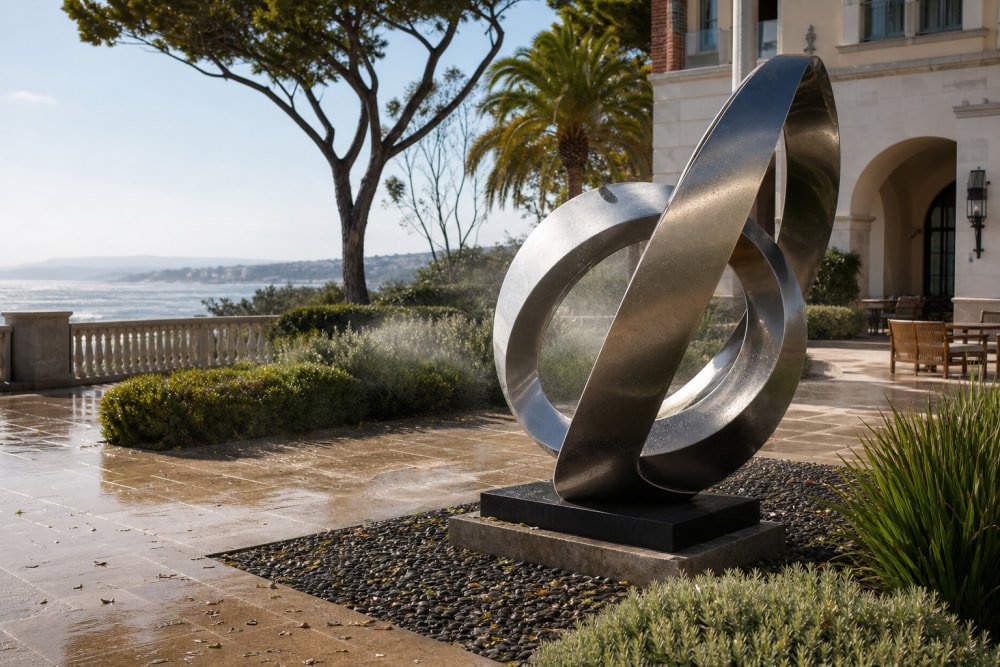
When I discuss stainless steel sculpture projects with overseas clients, I always ask about the location first. A sculpture does not live in a catalog photo. It lives in wind, rain, dust, sunlight and sometimes salt spray.
For normal garden exposure, stainless steel can perform very well when the material and surface treatment are suitable. I often remind clients that stainless steel resists corrosion; it does not magically reject every stain forever2.
Here are the main site factors I usually check:
| Site condition | Common risk | What I usually discuss before production |
|---|---|---|
| Coastal air | Salt deposits, tea staining, faster surface staining | Higher corrosion-resistant grade, smoother finish, more frequent cleaning |
| High humidity | Water marks, hidden moisture, staining | Better drainage, sealed joints, planned inspection |
| Rain and snow | Standing water, freeze-thaw stress around base | Base design, slope, drainage holes where suitable |
| Urban pollution | Dirt film, acidic deposits, dull surface | Easier-clean finish, scheduled washing |
| Strong sunlight | Coating aging, heat expansion | Coating suitability, color stability, supplier confirmation |
| Irrigation spray | Mineral spots, chemical residue | Avoid direct sprinkler contact, rinse schedule |
| Garden soil contact | Mud splash, fertilizer contact | Raised base, cleaning access, protective design |
For coastal villas, hotels, and public waterfront projects, I usually treat salt as the first enemy. Salt can remain on the surface after sea wind dries.3 If nobody cleans it away, it can cause brown stains or small rust-like marks, especially around scratches, welds, joints, and water-retention areas4.
In many projects, buyers ask for mirror-polished stainless steel because it looks modern and luxurious. I agree that it can be stunning. However, I also explain that a mirror surface shows fingerprints, water spots, and scratches more clearly. If the sculpture will stand near the sea, I usually recommend that the buyer confirm the stainless steel grade, polishing standard, and possible protective treatment with the supplier before signing production drawings.
My practical rule is simple: if the site is harsh, the protection plan must be stronger before the sculpture leaves the workshop.
A private garden may look gentle, but it can still create problems. Sprinklers may spray hard water onto the sculpture every morning. Fertilizers and lawn chemicals may touch the base. Leaves may hold moisture against the surface. Children or garden tools may scratch the finish.
So I suggest buyers and designers answer these questions early:
I have seen projects where the sculpture itself was well made, but the site created avoidable staining because sprinklers sprayed the same area every day. A small placement change could have helped.
Many buyers believe stainless steel outdoor metal sculptures will never rust. When the first brown spot appears, the buyer may think the sculpture has failed, even when the real issue is salt, dirt, scratches, or poor maintenance.
Stainless steel outdoor metal sculptures are corrosion-resistant, not permanently rust-proof. They can still develop staining, rust spots, or surface dullness when exposed to salt, pollution, scratches, trapped water, harsh chemicals, or poor cleaning. Good material selection and routine care reduce risk but do not remove it completely.
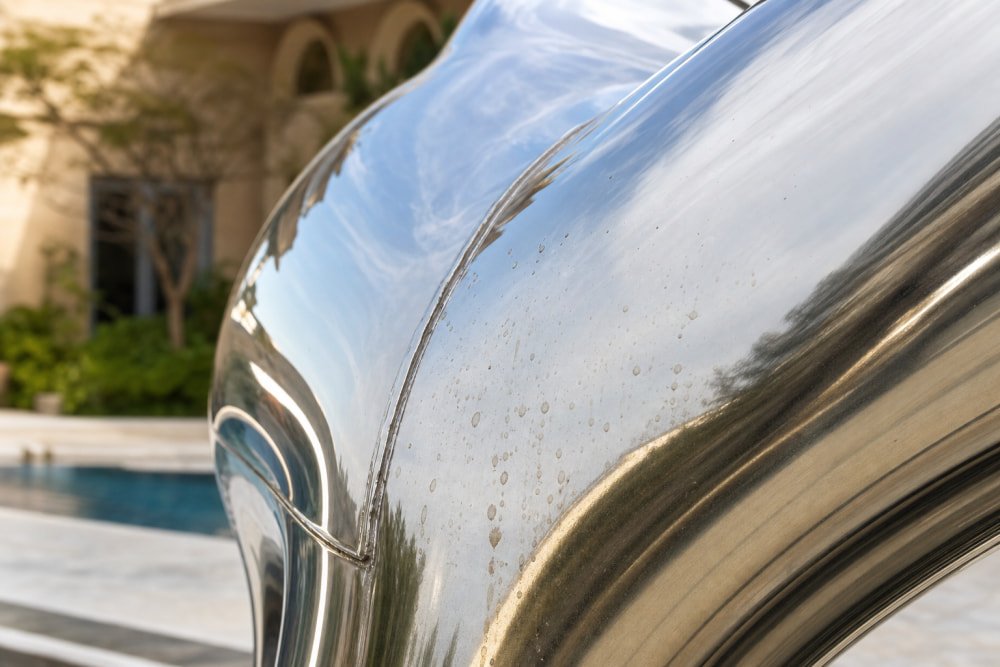
As a supplier, I would rather explain this point clearly before production than handle confusion after installation. Stainless steel contains chromium, which helps form a protective surface layer.5 This is why it is widely used for outdoor sculpture, architecture, railings, and public art. But that protective behavior depends on the surface condition and environment.
If the surface is damaged or covered with deposits, the metal can no longer perform perfectly. This is why stainless steel can show:
In sculpture projects, buyers may hear terms like 304 stainless steel and 316 stainless steel. In general industry use, 316 is often selected for better resistance in marine or chloride environments, while 304 is widely used in many standard outdoor and indoor applications6. However, I always suggest confirming the exact grade, sheet thickness, welding method, and finish with the supplier or a qualified specialist for the specific site.
A simple comparison helps:
| Item | 304 stainless steel | 316 stainless steel |
|---|---|---|
| Common use | General outdoor and indoor sculpture | More demanding outdoor or coastal conditions |
| Corrosion resistance | Good in many normal environments | Usually better in salt or chloride exposure |
| Cost | Usually lower | Usually higher |
| Buyer action | Confirm if site is mild | Consider for coastal or humid sites, with supplier confirmation |
I do not recommend choosing only by grade name. A sculpture made from better material can still stain if the polishing is poor, welds are rough, water is trapped, or no one cleans it.7 At the same time, a well-made sculpture in a mild environment may perform very well with ordinary planned care.
Outdoor metal sculptures can have different finishes:
Each finish has advantages and trade-offs.
| Finish type | Visual effect | Maintenance note |
|---|---|---|
| Mirror polish | Bright, luxury, reflective | Shows fingerprints, water spots, and scratches clearly |
| Brushed finish | Modern, softer reflection | Scratches may follow grain direction; cleaning should respect the grain |
| Painted finish | Strong color options | Coating quality and repair plan need confirmation |
| Matte finish | Calm and architectural | Dirt may be less obvious, but cleaning is still needed |
| Textured finish | Artistic and expressive | Dust can collect in low areas |
I often tell clients that the “best” finish is not only about beauty. It is about beauty plus realistic maintenance. A mirror sculpture at a private villa entrance may be perfect if staff can clean it regularly. The same finish in a windy, sandy, coastal site may need more care than the owner expects.
This article mainly focuses on stainless steel because many modern outdoor metal sculptures use it. However, bronze, iron, corten steel, aluminum, and painted metal all require different care. For example, bronze may develop patina, iron can rust quickly without strong coating, and corten steel is designed to form a weathered surface under suitable conditions8. I always recommend that buyers ask for material-specific care instructions.
Some buyers ask about protection only after installation. By then, many choices are already fixed. If the material, joints, base, surface finish, and coating were not planned correctly, cleaning alone cannot solve every problem. I believe protection should begin when the sculpture is still a drawing.
Outdoor metal sculptures should be protected before production by confirming the site environment, stainless steel grade, sheet thickness, welding quality, surface finish, drainage design, coating options, packing method, and maintenance expectations. These decisions reduce later risks more effectively than relying only on post-installation cleaning.
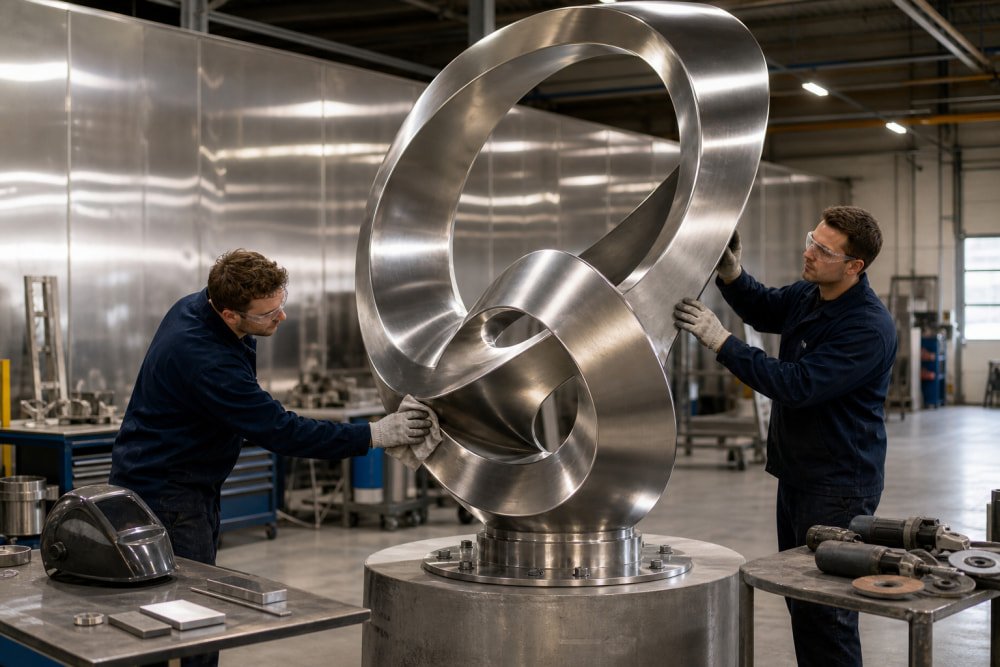
In our sculpture work, I see protection as a chain. If one link is weak, the final result suffers. A beautiful design can fail outdoors if water sits inside a joint. A strong structure can disappoint if the surface finish is too hard to maintain. A good polish can be damaged if packing is weak during export.
So I normally check several items before production.
For stainless steel sculptures, the buyer should ask for clear material information. This may include the stainless steel grade, sheet thickness, internal structure, and base connection. For large outdoor sculptures, engineering details also matter because wind load, installation method, and foundation design affect safety9.
I suggest buyers request:
For public spaces, large estates, or windy sites, I recommend professional engineering review. A sculpture is an artwork, but it is also a physical object that must stand safely for years.
Welds are important because they can become weak points for staining if not treated well. Rough welds can hold dirt and moisture.10 Poor polishing around seams can also make marks more visible.
Before shipment, I usually provide clients with photos and videos of:
For high-end projects, online inspection calls can help buyers check details before packing. This is especially useful for overseas clients who cannot visit the workshop.
A client may love mirror polishing after seeing photos, but I still ask where the sculpture will stand. If the location is close to the sea, a brushed or satin finish may sometimes be more practical. If the design requires a perfect mirror look, then the buyer should accept a stricter maintenance schedule.
Here is how I explain the decision:
| Buyer priority | Possible finish direction | Important reminder |
|---|---|---|
| Strong visual impact | Mirror polish | Needs careful handling and regular cleaning |
| Lower visible fingerprints | Brushed or satin | Clean along the grain direction |
| Color matching landscape design | Painted or coated finish | Confirm coating durability and repair method |
| Artistic texture | Hammered or textured finish | Watch dust and water collection |
| Easy long-term care | Simple forms, smoother surfaces | Avoid unnecessary water traps |
Some projects may use coatings, passivation, wax, or other protective treatments. These options can help in certain conditions, but they should not be sold as permanent protection. Coating performance depends on product type, surface preparation, climate, UV exposure, cleaning habits, and installation conditions.11
I do not give chemical promises unless the coating supplier or specialist confirms them. Instead, I ask practical questions:
This is the kind of discussion that protects buyers. It also avoids unrealistic expectations.
Export packing is part of protection. A stainless steel sculpture can leave the workshop in excellent condition but arrive with scratches if packing is poor. For international shipping, I prefer reinforced wooden crates, soft surface protection, moisture-proof wrapping where suitable, and stable internal fixing.
Buyers should ask for:
A sculpture’s outdoor life starts before it reaches the garden. Good packing helps the surface arrive ready for installation, not repair.
Many people want a one-time solution, but outdoor metal sculptures live in changing weather. Dust, rain, salt, insects, leaves, and human touch all return again and again. If maintenance is irregular, small stains can become harder to remove later.
A good maintenance schedule for outdoor metal sculptures includes gentle cleaning, regular inspection, early stain treatment, and avoidance of harsh chemicals. For normal sites, monthly or seasonal cleaning may be enough. For coastal, polluted, or high-touch sites, buyers should inspect and clean more often.12
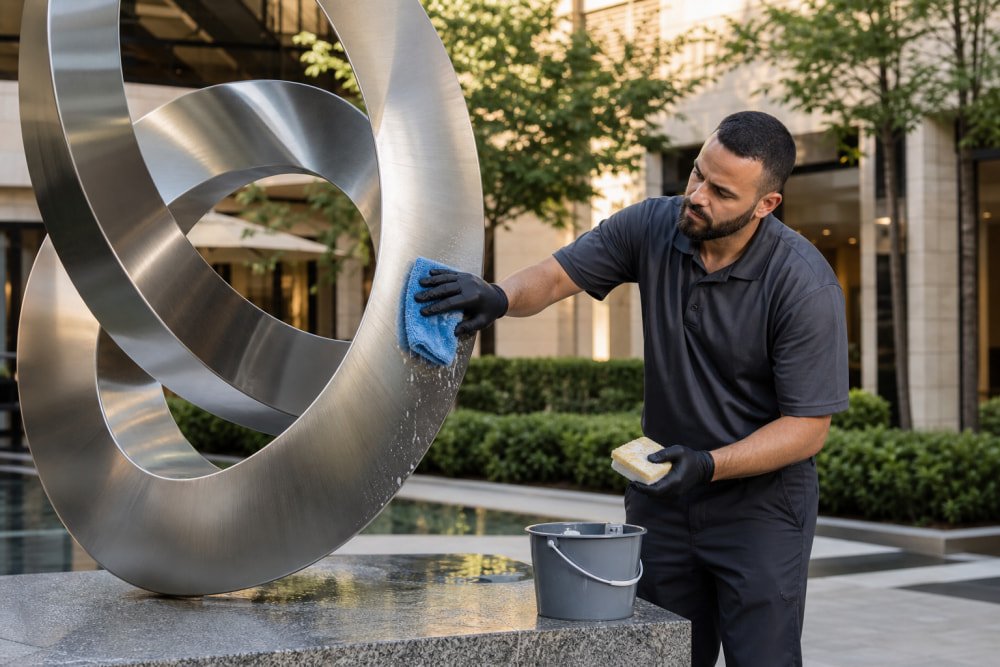
In most cases, complicated cleaning is not the best starting point. I prefer simple, safe habits:
This advice sounds ordinary, but ordinary care is powerful when it is consistent.
The right schedule depends on the site. I usually give buyers a flexible starting point:
| Environment | Suggested inspection | Suggested cleaning |
|---|---|---|
| Indoor or covered outdoor area | Every 2–3 months | As needed |
| Normal garden or courtyard | Monthly or every season | Monthly or after heavy dirt |
| Coastal area | Every 2–4 weeks | Often, especially after salt exposure |
| Polluted urban site | Monthly | Monthly or more often |
| Public high-touch sculpture | Weekly visual check | As needed based on contact |
| Snow or rainy climate | After harsh weather | Remove dirt and standing water when safe |
This table is not a laboratory rule. It is a practical guide. For high-value artworks, museums, public plazas, or unusual climates, I recommend a project-specific maintenance plan.
I always warn clients not to “fight stains” with aggressive methods too quickly. Strong cleaning can create more damage than the original mark.
Avoid these unless a qualified supplier or specialist confirms suitability:
If the sculpture has a coating, the buyer should follow the coating supplier’s cleaning instructions. A cleaner that is safe for bare stainless steel may not be safe for a clear coating or colored finish.
If small brown spots appear, I do not recommend panic. First, the owner should document the issue with clear photos. The photos should show the full sculpture, the close-up mark, and the surrounding environment. Then the owner should gently clean the area with water and mild soap. If the mark remains, the owner should contact the supplier for guidance.
Possible causes may include:
Some stains can be cleaned. Some scratches may need polishing repair. Some corrosion concerns may need professional passivation or specialist restoration. I avoid giving one universal treatment because the right method depends on the finish and cause.
I have seen cases where the sculpture was well made, but installation created problems. Workers used dirty gloves, dragged straps over polished surfaces, or allowed cement water to splash onto the metal. These small mistakes can stain or scratch the surface before the owner even sees the final result.
So I recommend that buyers share these points with installation teams:
A good maintenance cycle begins with a clean installation.
Many buyers focus only on price and delivery time. I understand budgets and schedules are important, but outdoor metal sculptures also need supplier judgment. If the supplier cannot explain material, finish, structure, packing, and maintenance, the buyer may carry hidden risk.
The best supplier questions for outdoor metal sculptures cover site suitability, stainless steel grade, surface treatment, welding quality, drainage, coating limits, export packing, installation support, and maintenance instructions. Clear answers help buyers compare suppliers by long-term display performance, not only by quotation.

For procurement managers, designers, art consultants, and private estate owners, supplier evaluation should be practical. I have worked with clients who sent only inspiration photos at first. After discussion, we clarified size, outdoor exposure, finish, foundation, and delivery requirements.
Here are the questions I suggest asking before ordering.
Ask:
I believe documents should be treated as documents to verify, not magic guarantees. If a project has strict requirements, buyers should ask for certificates, material reports, or third-party checks where appropriate.
Ask:
For high-end villa, manor, museum, or gallery projects, surface expectations should be written clearly. Words like “high quality” are not enough. Buyers should ask for reference photos, inspection videos, and acceptance details.
Ask:
For large outdoor sculptures, I recommend qualified engineering evaluation. Sculpture suppliers can provide production and installation guidance, but local building codes, soil conditions, wind loads, and public safety requirements may need local professionals.
Ask:
A responsible supplier should not promise “never rust” or “zero maintenance.” I trust suppliers more when they explain limits honestly.
Ask:
At Mily Art Sculpture, we normally use detailed photos, videos, export wooden crates, and communication before packing to reduce misunderstanding. I mention this not as a hard sales claim, but as a practical point: overseas sculpture buyers need visual confirmation because they cannot check the work in person every week.
I usually suggest monthly or seasonal cleaning for normal gardens. Coastal, polluted, or high-touch sites need more frequent cleaning, sometimes every 2–4 weeks. The goal is to remove salt, dust, and pollutants before they sit on the surface for too long.
Yes, stainless steel sculptures can show rust spots or staining outdoors. Stainless steel is corrosion-resistant, not permanently rust-proof. Salt air, scratches, trapped water, iron contamination, pollution, and poor maintenance can all cause surface problems over time.
For stainless steel, I recommend starting with clean water, a soft cloth, and mild neutral soap if needed. Buyers should avoid harsh chemicals, steel wool, and unknown cleaners. If the sculpture has a coating or special finish, the supplier’s maintenance instructions should come first.
316 stainless steel is often considered more suitable for coastal or chloride-heavy environments, but it is not the only factor. Surface finish, welding, polishing, drainage, and maintenance also matter. Buyers should confirm the correct grade with the supplier or a qualified specialist for the specific site.
No. Bronze, iron, corten steel, aluminum, and stainless steel need different care methods. Bronze may require patina protection, while iron usually needs strong coating and rust control. Buyers should always request material-specific maintenance guidance from the maker or a professional conservator.
Protecting outdoor metal sculptures is not just about wiping the surface after installation. I believe the best protection starts with site study, material choice, finish selection, production quality, careful shipping, correct installation, and realistic maintenance. Stainless steel can perform beautifully outdoors, but it still needs care and honest expectations. If you are planning a villa, estate, public art, or landscape sculpture project, contact Mily Art Sculpture to discuss the environment, design, material, and long-term display plan before production begins.
"Marine Atmospheric Corrosion of Carbon Steel: A Review - PMC - NIH", https://pmc.ncbi.nlm.nih.gov/articles/PMC5506973/. Corrosion-engineering literature identifies chloride deposition, moisture, atmospheric pollutants, coating exposure to sunlight, and water-retaining details as variables that influence outdoor metal deterioration; this supports the site-risk framework, although it does not predict the service life of any specific sculpture without local exposure data. Evidence role: general_support; source type: research. Supports: Environmental variables including chlorides, moisture, atmospheric pollution, UV exposure for coatings, and retained water are recognized contributors to corrosion or surface degradation in outdoor metals.. Scope note: Contextual support; site-specific performance still depends on alloy, finish, fabrication, and maintenance. ↩
"Case Study: How Chromium Protects Steel - UMich MSE", https://mse.engin.umich.edu/internal/demos/case-study-how-chromium-protects-steel. Materials-science references describe stainless steel as corrosion-resistant because of a chromium-rich passive film, while noting that this resistance can be compromised by chlorides, deposits, mechanical damage, or unsuitable cleaning; this supports the statement that stainless steel is not maintenance-free. Evidence role: expert_consensus; source type: education. Supports: Stainless steel resists corrosion through passivation but is not immune to staining or corrosion, especially where deposits, chlorides, or surface damage are present.. Scope note: General metallurgical support; it does not establish the condition of a particular sculpture. ↩
"Environmental Modification and Atmospheric Corrosion: Clear Water ...", https://www.waru.edu/sites/default/files/webform/documents/24936/DOD-AUG22-18547.pdf. Studies of marine atmospheric corrosion report that sea-salt aerosols deposit chloride-containing residues on exposed metals and that these residues can remain after wetting events dry, increasing the likelihood of localized staining or corrosion; this supports the coastal-risk mechanism rather than proving failure in every seaside installation. Evidence role: mechanism; source type: paper. Supports: Marine aerosols deposit chloride salts on exposed surfaces, and evaporation can leave chloride residues that contribute to atmospheric corrosion risk.. Scope note: Mechanistic support; actual staining depends on chloride load, rainfall, alloy grade, finish, and cleaning. ↩
"Microstructures and Corrosion/Localised ... - PMC", https://pmc.ncbi.nlm.nih.gov/articles/PMC10971813/. Corrosion references associate stainless steel tea staining and localized corrosion with chloride contamination, crevice conditions, weld-related surface changes, scratches, and areas where moisture is retained; this supports the listed risk locations while leaving the precise cause of any individual stain to inspection. Evidence role: mechanism; source type: research. Supports: Localized stainless steel staining and corrosion are more likely where chlorides, crevices, weld heat tint, scratches, or retained moisture disrupt or challenge the passive surface.. Scope note: Supports plausible causes and vulnerable areas, not diagnosis of a specific stain. ↩
"Revealing the Corrosion Resistance of 316 L Stainless Steel by an In ...", https://pmc.ncbi.nlm.nih.gov/articles/PMC9920300/. Reference works on stainless steel explain that chromium in the alloy forms a thin passive oxide film that provides corrosion resistance; this supports the metallurgical explanation, although the durability of the film depends on environment and surface condition. Evidence role: definition; source type: encyclopedia. Supports: Stainless steel is defined by chromium content, and chromium enables formation of a passive oxide layer that improves corrosion resistance.. Scope note: Definition-level support; it does not address a particular grade, finish, or exposure site. ↩
"Marine grade stainless", https://en.wikipedia.org/wiki/Marine_grade_stainless. Materials references generally distinguish 316 stainless steel from 304 by its improved resistance to chloride-induced pitting, largely associated with molybdenum additions; this supports the grade-comparison guidance, but final selection still requires project-specific exposure and design review. Evidence role: expert_consensus; source type: education. Supports: 316 stainless steel, because of its alloy composition including molybdenum, generally has better resistance to chloride-induced corrosion than 304, making it common in marine or chloride-bearing settings.. Scope note: General alloy comparison; it does not guarantee corrosion-free performance for 316 or unsuitability of 304 in all outdoor sites. ↩
"Understanding and controlling crevice corrosion in stainless steel", https://ir.library.oregonstate.edu/downloads/6q182k93q. Stainless steel industry guidance notes that corrosion performance depends on alloy selection together with fabrication, weld treatment, surface finish, design details that avoid crevices or retained moisture, and maintenance; this supports the statement that grade alone is insufficient. Evidence role: general_support; source type: institution. Supports: Stainless steel corrosion resistance is affected by fabrication quality, surface finish, weld treatment, design details that trap water, and cleaning practices, not only alloy grade.. Scope note: General practice guidance; it does not quantify the relative contribution of each factor for a specific sculpture. ↩
"Weathering steel", https://en.wikipedia.org/wiki/Weathering_steel. Transportation and materials guidance on weathering steel explains that the alloy is intended to develop a stable protective oxide patina under suitable wet-dry exposure cycles; this supports the description of corten steel, while noting that sheltered, continuously wet, marine, or deicing-salt environments may prevent ideal patina formation. Evidence role: definition; source type: government. Supports: Weathering steel develops a rust-like protective patina under alternating wet and dry atmospheric exposure, but performance is limited in unsuitable environments.. Scope note: Definition and contextual limitation; not all products marketed as corten steel will perform the same way. ↩
"Minimum Design Loads for Buildings and Other Structures", https://www.waterboards.ca.gov/waterrights/water_issues/programs/bay_delta/california_waterfix/exhibits/docs/dd_jardins/DDJ-148%20ASCE%207-10.pdf. Building-code and structural-engineering guidance treats wind loads, anchorage, installation details, and foundation capacity as safety-relevant design considerations for outdoor structures; this supports the need for engineering review of large sculptures, although local code requirements vary by jurisdiction. Evidence role: general_support; source type: government. Supports: Outdoor structures and installations must be designed for environmental loads, anchorage, and foundation conditions to maintain public safety.. Scope note: Contextual structural support; sculpture-specific requirements depend on geometry, site, soil, and applicable local codes. ↩
"Corrosion Behavior and Mechanism of 304 Stainless Steel ...", https://pmc.ncbi.nlm.nih.gov/articles/PMC12251300/. Research on stainless steel corrosion and fabrication shows that surface roughness, weld features, and crevice-like geometries can retain deposits and moisture, which can undermine passivity and encourage localized attack; this supports the weld-inspection advice without implying all rough welds will corrode. Evidence role: mechanism; source type: paper. Supports: Surface irregularities and weld areas can retain deposits and moisture, creating conditions that favor localized corrosion or staining in stainless steel.. Scope note: Mechanistic support; the severity depends on weld treatment, exposure, alloy, and maintenance. ↩
"Guide to Protective Coatings, Inspection, and Maintenance", https://www.usbr.gov/tsc/techreferences/mands/mands-pdfs/GuideToProtectiveCoatingsInspectionMaintenance2012_508.pdf. Protective-coatings literature identifies coating type, substrate preparation, environmental severity, ultraviolet exposure, application conditions, and maintenance as major determinants of coating service life; this supports the article’s caution that coatings are conditional rather than permanent protection. Evidence role: expert_consensus; source type: paper. Supports: Coating durability is affected by coating formulation, substrate preparation, environmental exposure, UV radiation, maintenance, and application or installation conditions.. Scope note: General coatings evidence; the service interval for a particular sculpture requires the coating manufacturer’s data and site exposure assessment. ↩
"Caring for Outdoor Sculpture | History Nebraska", https://history.nebraska.gov/wp-content/uploads/2022/10/doc_Caring-for-Outdoor-Sculpture.pdf. Stainless steel maintenance guidance commonly recommends increased cleaning frequency where chloride salts, industrial pollutants, dirt deposits, or frequent handling are present; this supports the article’s relative maintenance advice, although exact intervals should be adjusted to observed soiling and site conditions. Evidence role: general_support; source type: institution. Supports: Maintenance guidance for stainless steel commonly recommends more frequent cleaning in coastal, industrial, polluted, or high-deposition environments.. Scope note: Supports relative frequency, not the precise 2–4 week schedule for every site. ↩

 We only use the information provided above to contact you in relation to your inquiry. For further details, read our Privacy Policy.