
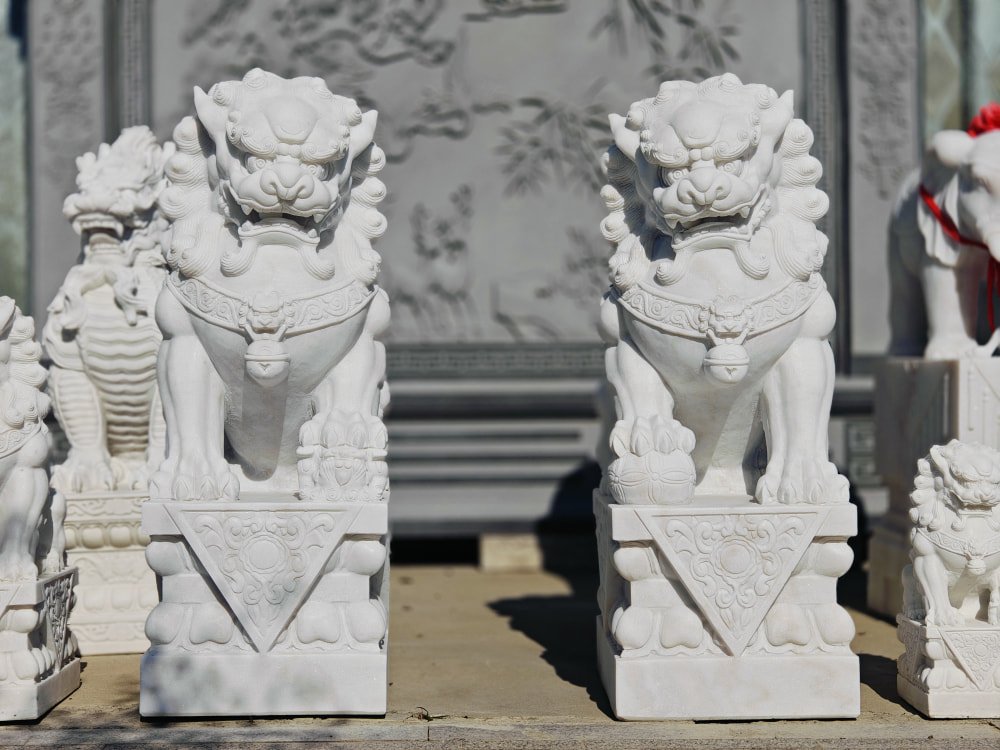
A Foo Dog is a stylized Chinese guardian lion, not a dog. Often called a stone lion (shíshī, 石狮) when carved in stone, it is commonly seen beside a gate or entrance. Look for a broad muzzle, a prominent mane and, in a familiar paired design, a ball beneath one lion’s paw and a cub beneath the other’s.

The quickest way to recognize the pair is to look down at the paws. The mane and expression may differ from one workshop or period to another, but the objects under the paws can tell you which figure you are looking at.
| What you see | What it tells you |
|---|---|
| A stylized lion beside an entrance, often with a companion | It may belong to the Chinese guardian lion tradition. Check the setting and the design rather than identifying it by its expression alone. |
| A lion with its paw on a patterned ball | In the familiar ball-and-cub pair, this is the male. |
| A lion with a smaller lion beneath its paw | In that pairing, this is the female. The smaller figure is a cub. |
| An open mouth, closed mouth or curled mane | These are features of the carving. On their own, they do not reliably identify the male or female. |
| A single lion or a pair without these objects | Look at the original setting or catalogue record. Not every historic guardian lion follows the ball-and-cub design. |
The ball and cub are easy to compare in two matching Chinese porcelain lions at The Metropolitan Museum of Art: the lion with a ball and the lion with a cub. The same motifs can appear in architectural stone or bronze, even though these museum examples are small porcelain objects.
“Foo Dog” and “Fu Dog” are English labels you will encounter in antique shops, garden catalogues and discussions of Chinese art. Chinese guardian lion is the clearer term when identifying the figure. “Stone lion” describes a stone example, so it is not the best material description for a cast bronze one.
The label “dog of Fo” has been associated with the Buddhist lion in museum literature. That association helps explain why the names coexist, but the English label is not a reason to identify the figure as a dog or as a particular breed. For a documented example, see the Buddhist lion entry in the Met exhibition catalogue The Splendor of Dresden.
Lions were not native to China, yet they became a familiar feature of Chinese architecture. Their arrival in records and their adoption in art are two different developments.
See the Met’s Northern Qi guardian lion and incense burner with lions for examples from different contexts. The Northern Qi lion is a useful reminder that the tradition is older and more varied than the modern garden pair.
Tian’anmen Gate is part of the Beijing Central Axis, inscribed on the World Heritage List in 2024. The lions here are best understood in relation to the gate and its approach. From a distance, look at how the paired sculptures frame the route. Up close, compare the objects beneath their paws and the relationship between each figure and its pedestal.
Those two views tell different stories: the wide view shows how guardians are used in architecture, while the close view shows how a carver distinguishes the two figures. The gate is an example of the tradition in an imperial setting; its arrangement should not be treated as a universal specification for a modern porch.
For a closer look at interpretations of the ball, cub and paired figures, read what Chinese marble Foo Dog statues mean.
First say where the viewer is standing. “Left of the door” changes meaning when you turn around.
For the arrangement illustrated in Mily’s marble guardian lion collection, the visitor standing outside and facing the entrance sees the cub lion on the left and the ball lion on the right. From the doorway looking outward, the ball lion is on the left and the cub lion on the right.
If you are matching an existing building or historic pair, use that site as your reference. For a new project, mark both figures directly on a photograph or plan. A note such as “ball lion on the right, viewed from the driveway” is clearer than “male on the right.”
Stone and bronze can use the same guardian lion motifs, but the materials give the details a different appearance. Compare the ball and cub, the depth of the mane and the shape of the base before comparing the finish.
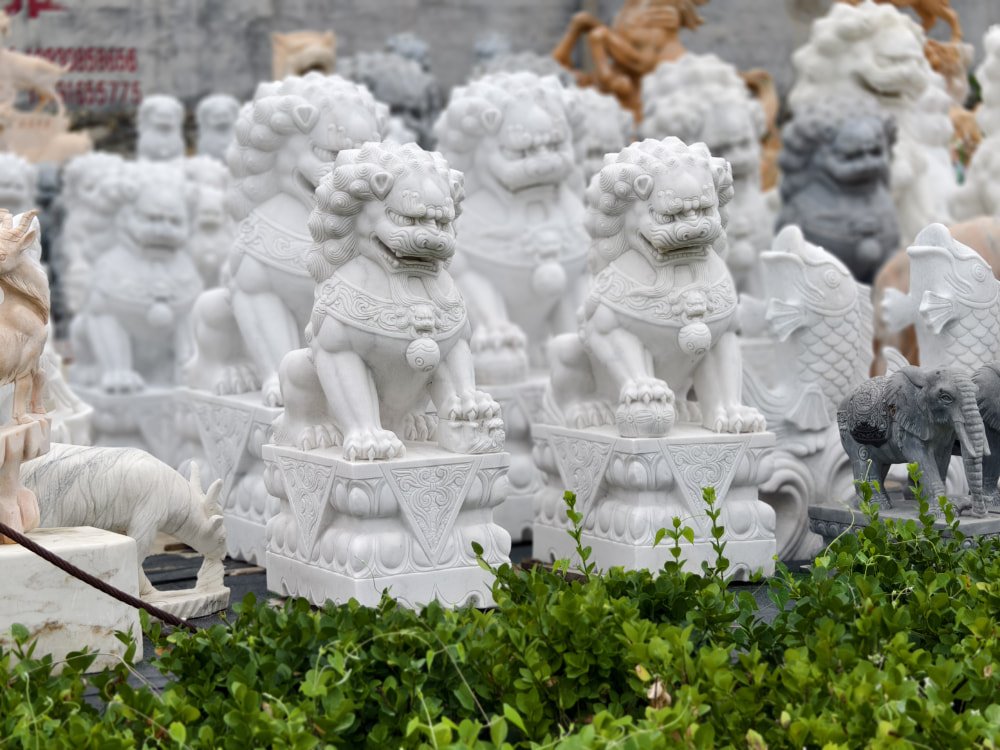
If you are planning an entrance, send a straight-on photo, the clear space on both sides and your intended height including the base. Those measurements help you compare suitable designs without relying on the scale of a product photo.
Is a Foo Dog the same as a Chinese guardian lion? In common English usage, yes. Chinese guardian lion is the more precise description.
Can a Foo Dog be shown alone? Individual figures exist, including museum objects and decorative pieces. A matched pair is familiar at an entrance, but a lone lion does not cease to be a guardian lion.
Can I tell the male from the female by its mouth? For the familiar Chinese ball-and-cub pair, use the paw details. An open or closed mouth is not a reliable substitute.

 We only use the information provided above to contact you in relation to your inquiry. For further details, read our Privacy Policy.