
Famous bronze sculptures include Rodin’s The Thinker, Donatello’s David, Eriksen’s The Little Mermaid and the ancient Charioteer of Delphi. This guide brings together 15 famous bronze statues and sculptural groups, with their artists, dates, locations and the details that help you recognize them.
Choose a work in the table to jump to its description. “Unknown” means that a sculptor cannot be securely identified; it does not mean the attribution has been omitted.
| Work | Artist | Date / version | Location / collection |
|---|---|---|---|
| 1. The Thinker (Le Penseur) | Auguste Rodin | Conceived 1880; enlarged 1904 | Musée Rodin, Paris, France; other casts worldwide |
| 2. David (Donatello’s Bronze David) | Donatello | 15th century; exact dating debated | Museo Nazionale del Bargello, Florence, Italy |
| 3. The Little Mermaid (Den lille Havfrue) | Edvard Eriksen | 1913 | Langelinie waterfront, Copenhagen, Denmark |
| 4. Manneken-Pis | Jérôme Duquesnoy the Elder | 1619 | Original: Brussels City Museum, Belgium; fountain: street replica |
| 5. Great Buddha of Kamakura (Kamakura Daibutsu) | Unknown; no securely identified sculptor | Construction began in 1252 | Kōtoku-in, Kamakura, Japan |
| 6. Man Pointing (L’Homme au doigt) | Alberto Giacometti | 1947 | Casts in multiple collections, including MoMA, New York, USA |
| 7. Walking Man I (L’Homme qui marche I) | Alberto Giacometti | 1960 | Casts in multiple collections, including Fondation Maeght, Saint-Paul-de-Vence, France |
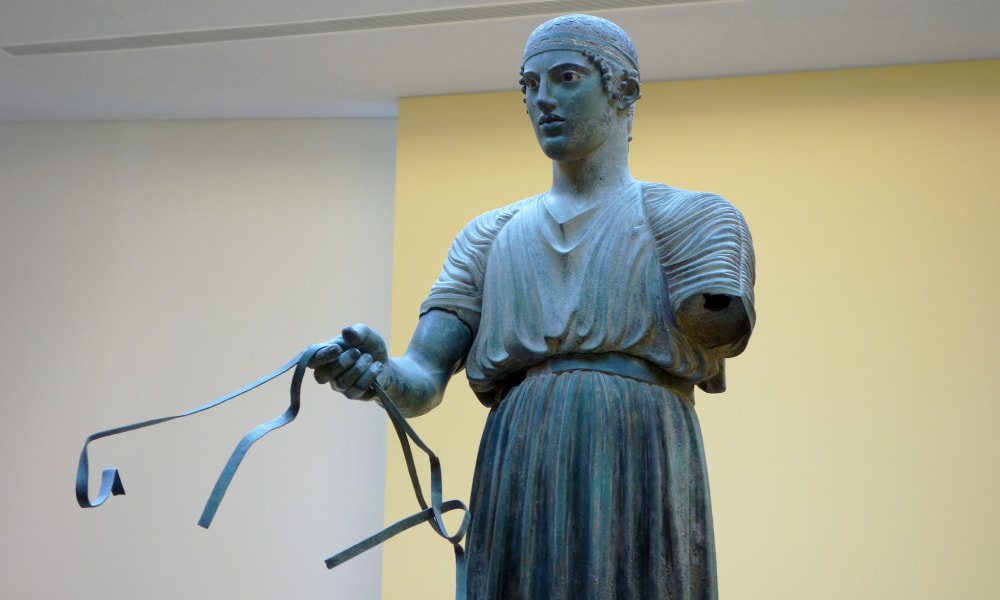
| 8. Charioteer of Delphi | Unknown ancient Greek sculptor | Early 5th century BCE, about 480–470 BCE | Delphi Archaeological Museum, Delphi, Greece |
| 9. Boxer at Rest (Seated Boxer / Terme Boxer) | Unknown ancient Greek sculptor | Hellenistic period; exact date debated | Museo Nazionale Romano, Palazzo Massimo alle Terme, Rome, Italy |
| 10. Statue of Unity | Ram V. Sutar | Inaugurated 2018 | Ekta Nagar / Kevadia area, Gujarat, India |
| 11. The Burghers of Calais (Les Bourgeois de Calais) | Auguste Rodin | Model completed 1889; Calais monument installed 1895 | Calais, France; other casts in museum collections |
| 12. Perseus with the Head of Medusa | Benvenuto Cellini | 1545–1554 | Loggia dei Lanzi, Piazza della Signoria, Florence, Italy |
| 13. Equestrian Statue of Marcus Aurelius | Unknown Roman sculptor | 2nd century CE; museum dating 161–180 CE | Original: Capitoline Museums, Rome, Italy; square: replica |
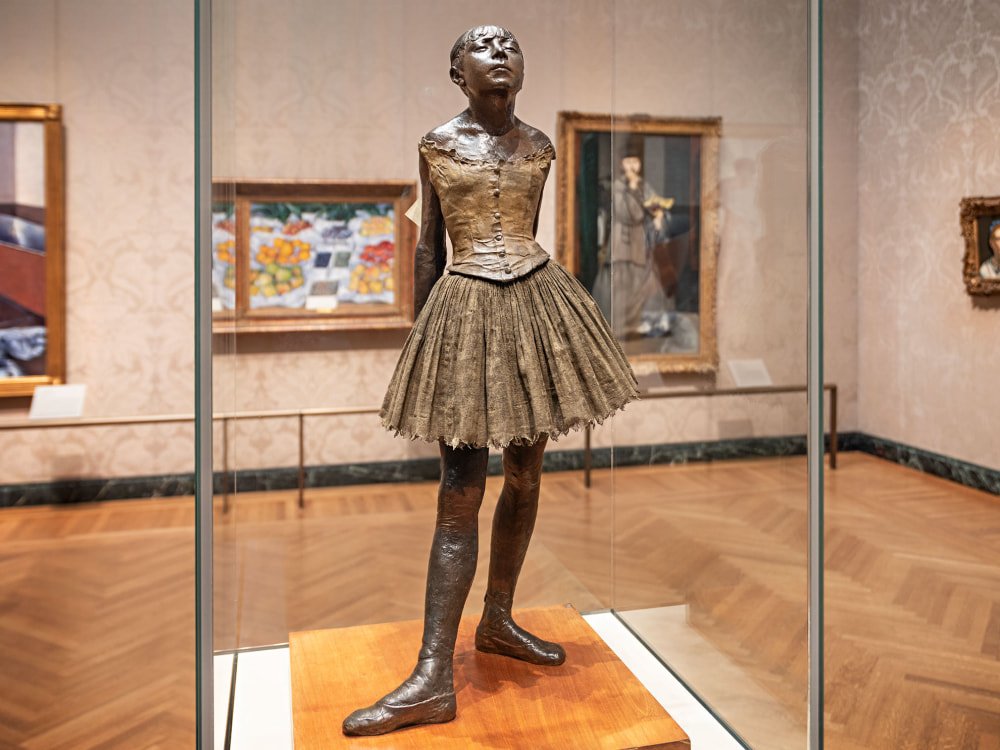
| 14. The Little Fourteen-Year-Old Dancer | Edgar Degas; bronze cast by A. A. Hébrard | Model 1881; Met bronze cast 1922 | The Metropolitan Museum of Art, New York, USA; other casts elsewhere |
| 15. Colossus of Rhodes — Lost Bronze Monument | Chares of Lindos | Early 3rd century BCE; destroyed in a 3rd-century-BCE earthquake | Ancient Rhodes, Greece; no surviving standing statue |
Rodin first conceived this seated figure for The Gates of Hell. Its compressed pose turns thinking into a physical effort: the bent back, tense limbs and hand beneath the chin all contribute to the effect. It became an independent sculpture and one of the most recognizable images in modern art. Do not give every Thinker the same casting date: the original conception, enlargement and individual bronze casts belong to different moments.

This youthful David stands after his victory over Goliath. His relaxed weight shift contrasts with the sword and severed head that explain the biblical story. The sculpture is a landmark of Renaissance bronze figure-making. Its date is debated, so a broad 15th-century attribution is more accurate than an unsupported exact year. Michelangelo’s David of 1501–1504 is marble and is not the bronze shown here.

Commissioned by Carl Jacobsen, this modestly scaled figure draws on Hans Christian Andersen’s fairy tale. The folded posture and gaze toward the shore convey longing rather than triumphant heroism. Its importance comes from the connection between literature, place and public memory, showing why a famous bronze statue need not be monumental in size.

The small fountain figure became an emblem of Brussels through its humour, civic traditions and costumes. The city commissioned Duquesnoy’s bronze in 1619. Its identity needs a location distinction: the historic original is in the museum, while the familiar outdoor fountain presents a replacement. A photograph of the street fountain should not be captioned as the museum’s original.

The seated image represents Amida, or Amitabha Buddha. The broad, balanced form and meditative pose give it a very different presence from the active figures elsewhere in this guide. The temple’s English description calls it a colossal copper image; it is widely discussed as a bronze or copper-alloy sculpture. Attribution should remain unknown rather than assigning a famous sculptor without evidence.

Giacometti reduces the body to an elongated, rough-surfaced figure, yet the outstretched gesture reaches forcefully into the surrounding space. Its fame rests on this striking treatment of the human presence. The work exists in more than one cast: MoMA documents one in its collection. A collection record is not proof that every photograph was taken there, nor a guarantee of current display.

A long stride and arms held close to the body give this attenuated figure a sense of motion without narrative props. Giacometti’s rough modelling makes the surface as expressive as the silhouette. The 1960 Walking Man I should not be confused with every earlier walking figure by the artist. Fondation Maeght documents this version and its relationship to the sculpture grouping in its Giacometti Courtyard.

The upright figure wears a long racing garment and once belonged to a larger chariot dedication. Its stillness, carefully handled folds and detailed head distinguish it from more theatrical modern sculpture. The museum identifies it as an early-5th-century bronze and displays it with surviving chariot fragments. The ancient original is a museum object; an outdoor copy should be clearly labelled as a replica.
The exhausted athlete sits with his head turned, still wearing boxing hand-wraps. His damaged face and alert expression make vulnerability as important as strength. Copper details contribute to the treatment of injuries. Dating is debated; the Met’s exhibition record gives a likely range between the late fourth and second centuries BCE. That page documents a past New York loan, while the home collection is Palazzo Massimo in Rome.

The 182-metre figure portrays Sardar Vallabhbhai Patel. Its inclusion illustrates monumental bronze construction rather than a single solid casting. Arup describes modular bronze façade panels supported by steel framing and concrete cores. Distinguishing the artistic design from the structural system gives readers a more useful understanding of the material than simply calling the entire monument bronze.

Six citizens face the prospect of sacrifice during the medieval siege of Calais. Rodin gives each figure an individual response through bowed heads, weighted drapery and expressive hands. Instead of isolating one victorious hero, the monument explores collective courage and distress. Dates should distinguish the completed model from the 1895 installation, and photographs of other casts should identify their own location.

Perseus holds Medusa’s severed head above her fallen body, creating a clear upward silhouette and a dramatic view from the square. The work is a major example of Renaissance bronze ambition. The Uffizi also explains its political setting under Cosimo I de’ Medici. Name Cellini as its sculptor and distinguish this outdoor bronze from other artists’ treatments of the Perseus story.

The emperor’s raised hand and controlled mount convey public authority. It belongs here as an imperial portrait and a landmark of monument design, rather than as an animal-themed attraction. The ancient bronze is protected inside the Capitoline Museums; the figure in Piazza del Campidoglio is a replica. A photograph needs to specify which installation it shows.

The young ballet student stands with her hands behind her back and her chin lifted. The familiar bronze is not the material in which Degas first exhibited the figure: the 1881 version was wax with real clothing. The Met documents its bronze cast as 1922, with a modern tutu. Distinguishing the model from posthumous bronze casts avoids the misleading statement that Degas exhibited this bronze in 1881.
The colossal image of the sun god Helios remains famous through ancient accounts and its place among the Seven Wonders. Its exact appearance and placement cannot be checked against an intact surviving statue. Modern harbour illustrations are reconstructions, not photographs of the ancient work. It is included as a historically important lost monument, clearly separated from the surviving statues and documented casts above.
No. Its outer skin is copper sheet, rather than cast bronze. The National Park Service explains the repoussé copper construction. A green surface alone cannot establish whether a statue is bronze or copper, which is why Liberty is not one of the 15 bronze works above.
There is more than one famous David. Donatello’s bronze David is at the Bargello; Michelangelo’s monumental David is marble. Later reproductions may use a different material from their historical model. Identify the artist and version before writing a caption or comparing products.
A model can produce multiple bronze casts. The artist’s model date, a particular cast’s date and its installation date may differ. Museum collection pages help establish which object is being discussed. Likewise, an outdoor replica may stand where an original once stood, as with Manneken-Pis and Marcus Aurelius.
They have a dedicated US bronze animal landmark guide. Charging Bull and other wildlife subjects are not repeated as full entries here. This keeps the general art-history selection distinct from the animal-specific list.
The historical works above are reference examples, not Mily inventory or claims of museum affiliation. For a garden, memorial, hotel or public-space project, start with the subject, dimensions and intended setting. Then confirm the actual alloy, modelling approval, surface finish, mounting requirements and delivery scope for the proposed piece.
For a historical reproduction, specify the exact artist and version. A modern decorative replica is not an original or an artist-authorized edition; for a contemporary work, confirm the required reproduction permission before proceeding.

 We only use the information provided above to contact you in relation to your inquiry. For further details, read our Privacy Policy.