

Choosing the wrong material for an outdoor statue is an expensive mistake. I have seen buyers spend thousands of dollars on a piece that starts peeling or turning green in two years.
The short answer: for long-term outdoor display, bronze is the most reliable choice. It resists corrosion, holds its surface quality for decades, and builds real collector value over time. But brass and resin both have legitimate roles — if you know exactly where and how to use them.
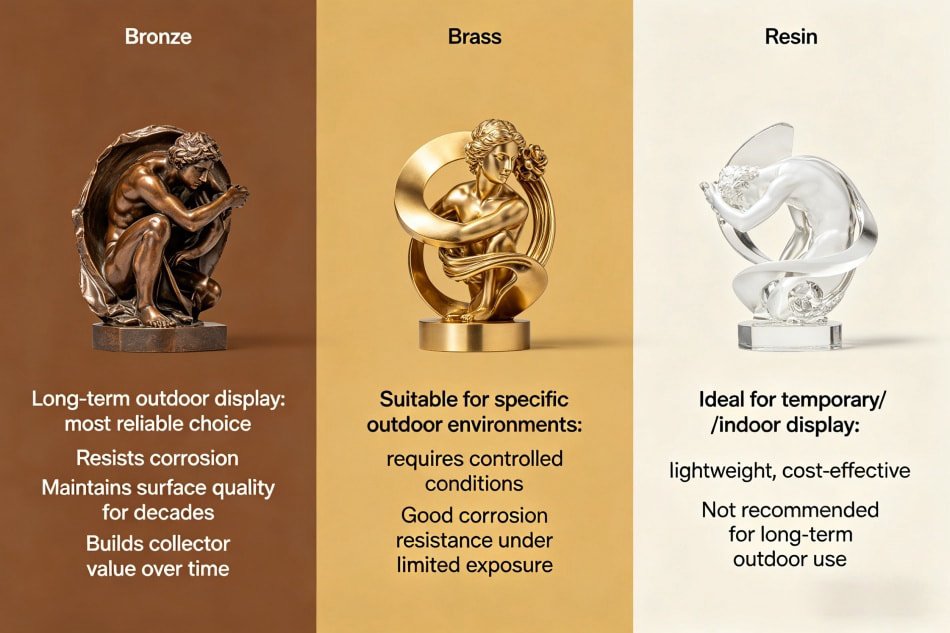
Over the past 40 years, I have worked on hundreds of export projects — coastal villas in Europe, estate gardens in North America, public plazas in the Middle East. The most common mistake I see is not a bad sculpture. It is a good sculpture made from the wrong material for the project. This article walks through each material honestly, so you can make the right call before the order is placed.
Every year, I get buyers who tell me they want a "bronze-looking" statue. When I ask what material they actually want, the answer is often unclear. That confusion alone has caused more project problems than I can count.
Bronze is a copper-tin alloy, typically with copper content above 85–90%.1 It has excellent corrosion resistance, handles outdoor humidity and temperature changes well, and develops a natural patina over time that actually protects the surface.2 A well-made bronze statue can last 50 to 100 years outdoors with basic care.3
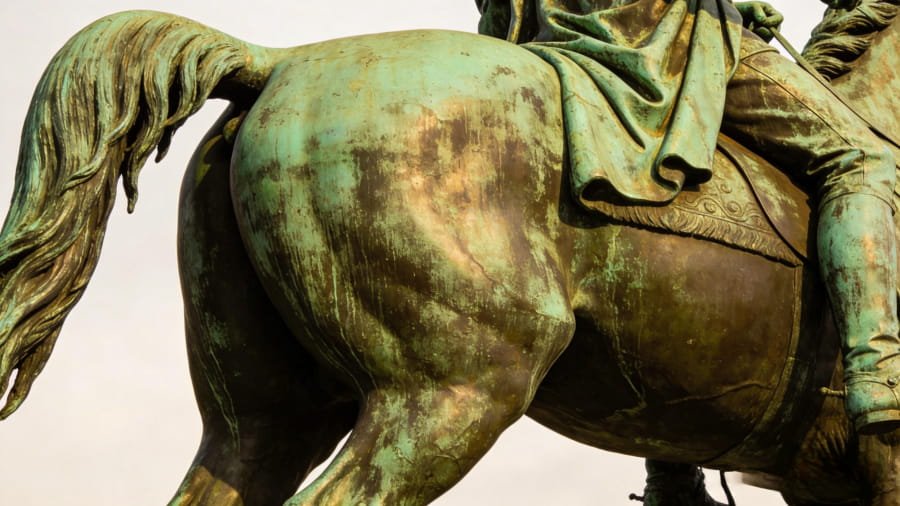
I think of bronze as the "heirloom quality" option. This is not just a marketing phrase. When a villa owner installs a bronze statue in their garden today, their grandchildren will still be looking at the same piece decades later. That kind of longevity is what justifies the price for serious buyers.
Here is something I tell every procurement manager who comes to me with two bronze quotes that look nothing alike in price: the word "bronze" on a quote tells you almost nothing by itself.
The quality gap inside the bronze category is enormous. Two statues can both be described as "bronze" and yet be completely different products. The casting method, the wall thickness, the surface treatment, and the patina process all determine what you are actually buying.
The biggest quality driver is the casting method. Lost-wax casting (also called investment casting) is the traditional method used for fine art bronze.4 It captures sharp detail, produces consistent wall thickness, and allows the sculptor's original texture to come through clearly.5 Sand casting is faster and cheaper, but it produces a rougher surface and less precise detail.
Wall thickness matters for outdoor durability. Thinner walls mean the piece is lighter and cheaper to produce, but more vulnerable to physical damage and long-term structural stress. For large outdoor statues — anything over 1 meter — I always recommend a minimum wall thickness that can handle wind load and temperature expansion.
Surface treatment is where many buyers get surprised. A proper outdoor bronze finish includes chemical patina application, anti-corrosion coating, and in some cases a final wax layer before shipping. A statue without proper surface sealing will oxidize unevenly and look neglected within a few years, even if the base material is high-quality bronze.
Here is a simple breakdown of what drives bronze pricing:
| Factor | Lower-Cost Option | Higher-Cost Option |
|---|---|---|
| Casting method | Sand casting | Lost-wax casting |
| Wall thickness | Thin (under specification) | Engineered to project scale |
| Surface patina | Single-color spray | Hand-applied chemical patina |
| Anti-corrosion coating | Basic or none | Multi-layer outdoor-grade coating |
| Detail quality | Rough surface, lost texture | Sharp, faithful to original model |
When you receive two bronze quotes and one is 40% cheaper, this table is where the difference lives. I always ask buyers to request casting method and wall thickness specs before comparing prices. Without that, you are not comparing the same product.
Brass looks beautiful in a showroom. The warm, golden tone is eye-catching, and many buyers initially prefer it over the darker, more muted look of bronze. I understand the appeal.
Brass is a copper-zinc alloy.6 It has a brighter, more golden color than bronze. However, zinc corrodes faster than tin in outdoor conditions, especially in high-humidity or coastal environments.7 This means brass oxidizes more aggressively outdoors and requires more frequent maintenance to hold its appearance.

This does not mean brass is a bad material. It means brass is the right material in specific contexts — and the wrong material in others. The problem I see most often is buyers using the words "bronze" and "brass" interchangeably when placing orders. These are different alloys with different outdoor performance profiles. Treating them as the same is a sourcing error that shows up years after delivery.
Brass performs well in sheltered or semi-outdoor spaces. A covered entrance, an interior courtyard with a roof, an indoor lobby with some natural light — these are environments where brass can hold its look without excessive maintenance. The piece gets the visual warmth of a gold tone without the harsher outdoor degradation that would occur in a fully exposed garden.
Brass is also used in specific decorative styles where the golden color is part of the design intent. Some classical European architectural styles, certain Middle Eastern decorative traditions, and high-gloss interior design projects specifically call for the brass tone. In those cases, using brass is a deliberate aesthetic choice, not a cost-cutting shortcut.
Where brass fails is in coastal environments, high-rainfall climates, and fully exposed outdoor installations with no shelter. Salt air accelerates zinc corrosion significantly.8 I have seen brass statues in coastal villa gardens develop uneven, patchy oxidation within 18 months. That is not a surface problem you can fix with a quick wax. It requires professional restoration.
| Environment | Brass Suitability | Recommended Instead |
|---|---|---|
| Coastal / salt air | Not recommended | Bronze |
| High rainfall, fully exposed | Not recommended | Bronze |
| Sheltered courtyard / covered entrance | Acceptable | Bronze or Brass |
| Indoor lobby / gallery | Good | Bronze, Brass, or Resin |
| Dry climate, partially sheltered | Acceptable with maintenance | Bronze preferred |
My general rule: if the piece will be fully exposed to weather for more than five years, choose bronze over brass. If the piece is sheltered and the golden tone is important to the design, brass is a reasonable choice — with a clear maintenance plan in place.
I want to be direct here because I think resin gets an unfair reputation in the high-end sculpture world. The honest answer is: resin is not always cheap, and it is not always the wrong choice. But it is often the wrong choice for fully exposed outdoor use, and buyers need to understand why.
Resin (including fiberglass-reinforced resin) is lightweight, affordable, and can be cast in fine detail.9 For fully exposed outdoor environments, its realistic lifespan is around 3 to 5 years before UV degradation, surface cracking, and color fading become visible problems.10 It is not engineered for long-term outdoor exposure.
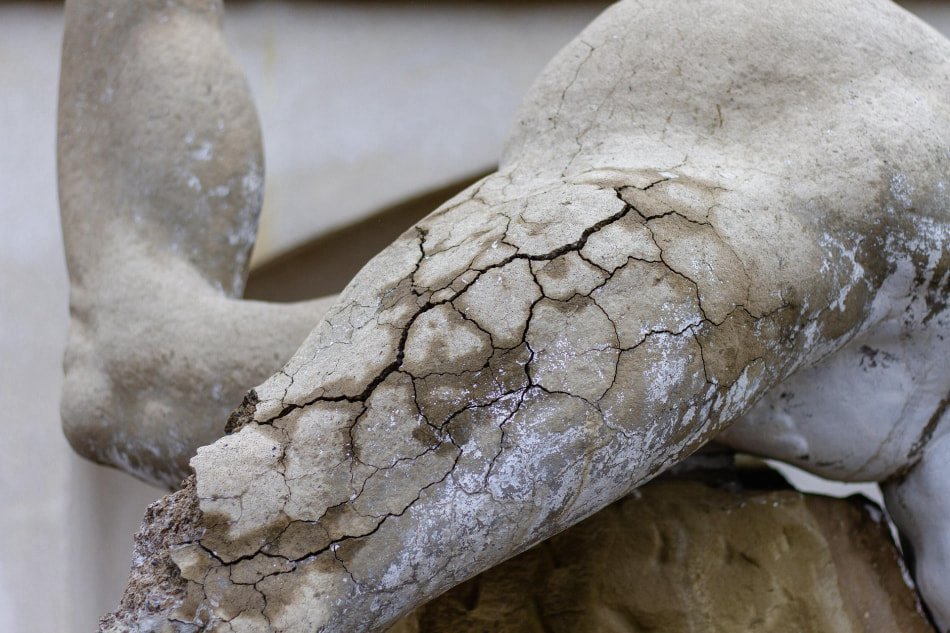
I have had clients come back to me after buying resin statues from a cheaper source, frustrated that the piece looked faded and cracked after two summers. This is not a defect. It is the expected behavior of the material in full outdoor exposure. The product was not misrepresented — the buyer just did not understand what they were buying.
Here is the scenario where I would confidently recommend resin: a covered outdoor space, a temporary installation, an indoor-outdoor transitional zone like a conservatory or a hotel lobby entrance with a roof overhang, or a project where the budget is fixed and the piece will not face direct sun and rain year-round.
Resin also makes sense for large-scale decorative pieces where weight is a constraint. A rooftop installation, a balcony feature, or a display piece that needs to be moved seasonally — these are cases where the lightweight nature of resin is a practical advantage, not just a cost-saving measure.
The scenario where resin is clearly wrong: a garden statue in a fully exposed plot in a coastal European estate, a public plaza installation expected to last 20 years, or any piece that a client expects to hold collector or heirloom value. In those cases, resin will disappoint, and the buyer will pay twice — once for the resin piece and once for the bronze replacement.
| Use Case | Resin Appropriate? | Notes |
|---|---|---|
| Fully exposed garden, 10+ year lifespan | No | Use bronze |
| Covered outdoor space, 3–5 year display | Yes | Protect from direct sun and rain |
| Temporary event or seasonal installation | Yes | Lightweight advantage, easy to move |
| Indoor lobby or gallery display | Yes | No weather exposure, resin performs well |
| Public plaza, permanent installation | No | Use bronze or stainless steel |
| Budget-sensitive project, sheltered location | Yes | Intelligent choice, not a compromise |
The key mindset shift I ask buyers to make: stop asking "is resin good or bad?" and start asking "is resin right for this specific location and timeline?" That question will give you a much more useful answer.
One of the most common questions I get from villa and estate owners is: "Once the statue is installed, what do we actually need to do?" This is the right question to ask before purchase, not after.
The most important and most accessible maintenance step for bronze is regular waxing. Applying a quality paste wax — the same type used for cars or quality furniture — to a clean bronze surface every 6 to 12 months creates a protective barrier against moisture and pollutants.11 This single step can preserve the surface quality of a bronze statue for 50 years or more.
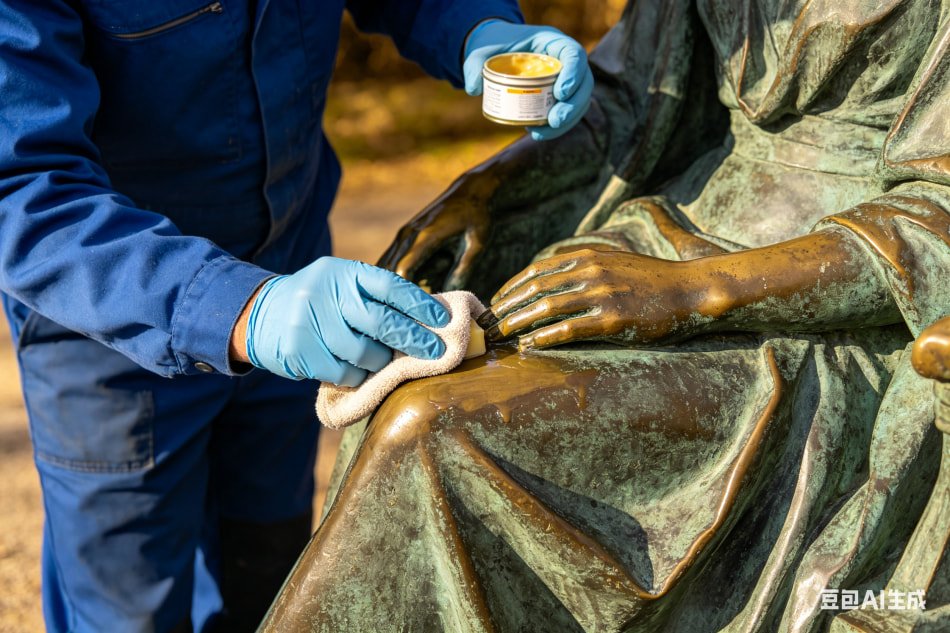
I tell clients that bronze maintenance is not complicated, but it does require consistency. The statue does not need a professional restorer every year. It needs a basic routine that any property manager or groundskeeper can follow.
The natural patina on a bronze statue is not damage — it is protection.12 The green or brown surface layer that develops over time is called verdigris or oxidation, and it forms a stable barrier that slows further corrosion. Many collectors and designers actually value this aged look. But if you want to preserve a specific finish — a polished brown, a dark antique tone, or a custom patina color applied at the factory — then regular maintenance is what keeps that finish intact.
Here is the routine I recommend to most of our clients:
Step 1 — Clean the surface. Use clean water and a soft cloth or brush to remove dust, bird droppings, and surface debris. Avoid abrasive cleaners or metal brushes. These scratch the surface coating and accelerate oxidation in the damaged areas.
Step 2 — Dry completely. Let the statue dry fully before applying any wax. Moisture trapped under wax will cause uneven oxidation.
Step 3 — Apply paste wax. Use a soft cloth to apply a thin, even layer of paste wax over the entire surface. Work it into any textured or recessed areas. Renaissance Wax is a product commonly used by museum conservators and is available to general buyers. Standard automotive paste wax also works well for outdoor bronze.
Step 4 — Buff the surface. After the wax hazes (usually 10–15 minutes), buff with a clean soft cloth to bring up the finish.
Step 5 — Inspect for damage. Check for any areas where the surface coating has chipped, scratched, or worn through. These spots are entry points for accelerated corrosion. Mark them for touch-up or contact your supplier for guidance on spot treatment.
| Maintenance Task | Frequency | Difficulty |
|---|---|---|
| Surface cleaning | Every 3–6 months | Easy |
| Paste wax application | Every 6–12 months | Easy |
| Surface inspection | Annually | Easy |
| Anti-corrosion coating touch-up | Every 5–10 years | Professional recommended |
| Full professional restoration | Every 20–30 years (if needed) | Professional |
The statues I have seen last the longest are not always the most expensive ones. They are the ones that received consistent basic care from the start. A bronze statue that is cleaned and waxed twice a year will outlast a higher-priced piece that was installed and never touched again.
For permanent outdoor display, bronze is the most reliable material. Brass suits sheltered spaces with the right design context. Resin works for covered, temporary, or budget-sensitive projects — but not for long-term outdoor exposure. Match the material to the environment, not just the look.
If you are working on a project and are not sure which material fits your site conditions, timeline, and budget, I am happy to walk through the specifics with you. At <a href="https://www.milystatue.com/" data-wpil-monitor-id="2">Mily Art Sculpture</a>, we have handled material selection consulting for coastal estates, public plazas, and private collections across Europe, North America, and the Middle East. Contact us directly and tell us about your project — we will give you a straight answer based on real project experience, not a sales pitch.
"List of copper alloys - Wikipedia", https://en.wikipedia.org/wiki/List_of_copper_alloys. Standard references describe bronze as a copper-based alloy, most commonly with tin as the principal alloying element; many traditional bronzes are predominantly copper by mass, though exact composition varies by application and alloy grade. Evidence role: definition; source type: encyclopedia. Supports: That bronze is principally a copper alloy usually alloyed with tin, with many common bronzes containing a high proportion of copper.. Scope note: The support is definitional and contextual because bronze includes multiple standardized and non-standardized alloy compositions rather than a single fixed copper percentage. ↩
"Protective treatments for copper alloy artworks: preliminary studies ...", https://pmc.ncbi.nlm.nih.gov/articles/PMC9995518/. Corrosion studies on copper alloys report that atmospheric exposure commonly produces a surface patina whose corrosion products can slow subsequent metal loss, helping explain bronze's comparatively good outdoor durability. Evidence role: mechanism; source type: paper. Supports: That copper alloys such as bronze can form corrosion products or patinas that reduce further corrosion under many atmospheric conditions.. Scope note: The protection afforded by patina depends on environment, pollutants, chloride exposure, and maintenance; not all patinas are equally stable or protective. ↩
"[PDF] Conserving Outdoor Painted Sculpture - Getty Museum", https://www.getty.edu/conservation/publications_resources/pdf_publications/pdf/conserv_outdoor_painted.pdf. Conservation literature on outdoor bronze monuments documents service lives extending over many decades, supporting the view that well-cast <a href="https://www.milystatue.com/bronze-elk-statues-a-comprehensive-guide-to-selecting-and-maintaining-your-perfect-piece/" data-wpil-monitor-id="4">bronze sculptures</a> can remain outdoors for half a century or longer when exposed under manageable conditions and given periodic maintenance. Evidence role: general_support; source type: research. Supports: That bronze monuments and sculptures are known to survive for many decades outdoors when manufactured appropriately and maintained.. Scope note: The evidence is contextual rather than a uniform engineering guarantee because service life depends on alloy composition, casting quality, local pollution, marine exposure, and upkeep. ↩
"Bronze sculpture - Wikipedia", https://en.wikipedia.org/wiki/Bronze_sculpture. Art-historical and technical sources identify lost-wax casting, or investment casting, as the long-established process by which bronze sculpture has traditionally been made, especially when detailed surface reproduction is required. Evidence role: historical_context; source type: education. Supports: That lost-wax casting is a historically established method for producing bronze sculpture and fine detail metalwork.. ↩
"Lost-wax casting - Wikipedia", https://en.wikipedia.org/wiki/Lost-wax_casting. Technical descriptions of investment casting note its suitability for reproducing intricate geometry and fine surface detail with relatively good dimensional control, which helps explain its use for sculptures requiring faithful transfer of model texture. Evidence role: mechanism; source type: research. Supports: That investment casting is valued for detailed reproduction, good surface finish, and dimensional control.. Scope note: The support is indirect for large sculptures because achievable wall uniformity and detail also depend on foundry practice, section size, and post-casting finishing. ↩
"Brass - Wikipedia", https://en.wikipedia.org/wiki/Brass. Standard materials references define brass as a copper alloy in which zinc is the principal alloying element. Evidence role: definition; source type: encyclopedia. Supports: That brass is conventionally defined as a copper-zinc alloy.. ↩
"Early Stages of Metal Corrosion in Coastal Archaeological Sites - PMC", https://pmc.ncbi.nlm.nih.gov/articles/PMC10820586/. Corrosion research comparing copper alloys indicates that zinc-containing brasses are generally more vulnerable than many tin bronzes in humid or chloride-bearing atmospheres, helping account for their poorer outdoor performance near coasts. Evidence role: mechanism; source type: paper. Supports: That zinc-bearing copper alloys are more susceptible than tin-bearing copper alloys in corrosive outdoor or chloride-rich environments.. Scope note: This is a comparative generalization; actual corrosion behavior depends on specific alloy composition, pollutants, microstructure, and protective coatings. ↩
"Initial oxidation of brass induced by humidified air - PMC - NIH", https://pmc.ncbi.nlm.nih.gov/articles/PMC3587402/. Atmospheric-corrosion guidance for marine environments reports that airborne chlorides increase corrosion rates for zinc and zinc-bearing alloys, which is consistent with faster deterioration of brass in salt-air exposure. Evidence role: mechanism; source type: government. Supports: That chloride-rich marine atmospheres accelerate corrosion processes affecting zinc and zinc-containing alloys.. Scope note: The source would support the general effect of chlorides on zinc-containing materials rather than directly measuring every decorative brass alloy used in sculpture. ↩
"Lightweight Glass Fiber-Reinforced Polymer Composite for ... - PMC", https://pmc.ncbi.nlm.nih.gov/articles/PMC9824407/. Materials-engineering references describe polymer and fiberglass-reinforced composite components as much lighter than cast metals and readily moldable into complex, detailed shapes, supporting their use where low weight and detail reproduction are important. Evidence role: general_support; source type: education. Supports: That polymer and fiberglass-reinforced composites are substantially lighter than metals and can be molded with detailed surface features.. Scope note: The affordability aspect is contextual because cost depends on size, tooling, finish quality, labor, and production volume. ↩
"A Review of Weathering Studies in Plastics and Biocomposites ...", https://pmc.ncbi.nlm.nih.gov/articles/PMC11054226/. Polymer weathering literature shows that prolonged outdoor ultraviolet exposure can produce fading, embrittlement, and surface cracking in many resin systems, which supports concerns about visible deterioration in exposed resin sculptures after several years. Evidence role: general_support; source type: paper. Supports: That outdoor UV exposure can degrade resin systems, causing discoloration, embrittlement, surface cracking, and loss of appearance over time.. Scope note: The 3–5 year interval is contextual rather than universal because durability varies widely with resin chemistry, reinforcement, pigments, gel coat, climate, and maintenance. ↩
"[PDF] Caring for Outdoor Bronze Plaques, Part II: Cleaning and Waxing", https://www.nps.gov/subjects/museums/upload/10-05_508.pdf. Preservation guidance for outdoor bronze sculpture describes paste wax coatings as a routine maintenance measure that helps shed moisture and reduce direct contact between the metal surface and atmospheric pollutants. Evidence role: expert_consensus; source type: government. Supports: That waxing is a recognized maintenance practice for outdoor bronze and functions as a sacrificial or protective coating against environmental exposure.. Scope note: Specific products and reapplication intervals vary by climate, exposure level, and existing coating system, so the 6–12 month schedule is a typical practice rather than a universal rule. ↩
"Protection of Patinated Bronze with Long-Chain Phosphonic Acid ...", https://pmc.ncbi.nlm.nih.gov/articles/PMC9959202/. Conservation guidance for bronze objects notes that stable surface patinas on copper alloys are often retained because they can function as a protective layer while also contributing to the object's historic and aesthetic character. Evidence role: expert_consensus; source type: institution. Supports: That stable patinas on bronze and other copper alloys can act as a protective layer valued in conservation practice.. Scope note: This is not a claim that every green or brown surface layer is benign; unstable chloride-driven corrosion products may still require treatment. ↩

 We only use the information provided above to contact you in relation to your inquiry. For further details, read our Privacy Policy.