

Buying a large sculpture1 from China sounds complicated. Shipping, customs, crating, installation — most buyers freeze before they even start.
Importing a large sculpture from China is more straightforward than most buyers think.2 With the right crating, a clear shipping plan, and a supplier with real export experience, your sculpture can arrive safely at your door — no freight forwarder needed on your end.
We have been exporting sculptures to Europe, North America, the Middle East and Australia for over 20 years. I want to walk you through the whole process in plain language — packaging, shipping options, installation, and what to do if something goes wrong. By the end of this post, you will know exactly what to expect.
A lot of buyers ask me: "Will it survive the journey?" That is a fair question. A marble statue can weigh 500 kg or more, and it has to travel by sea, then by truck, sometimes on roads that are far from smooth.
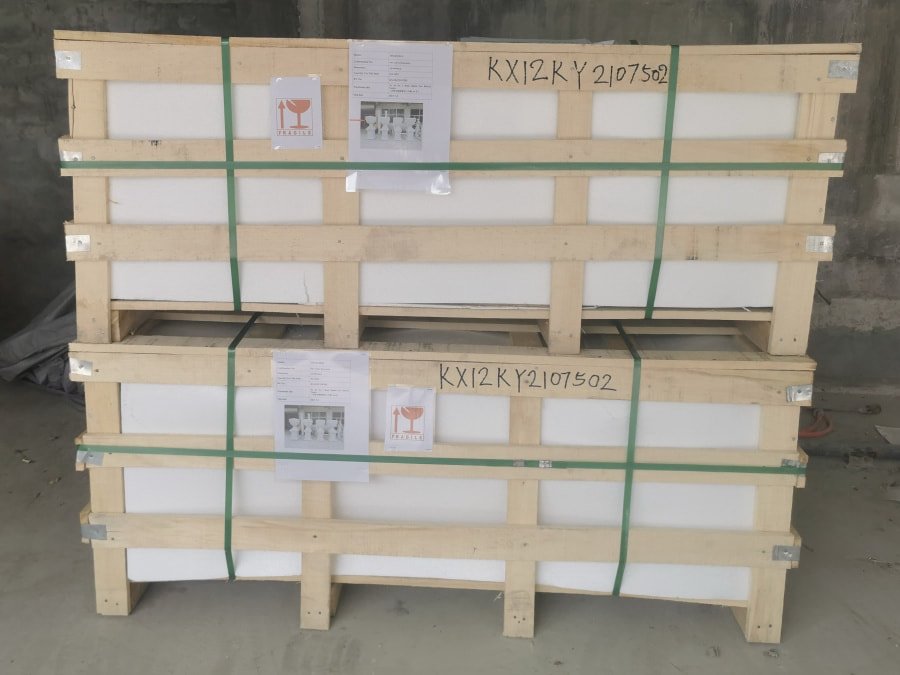
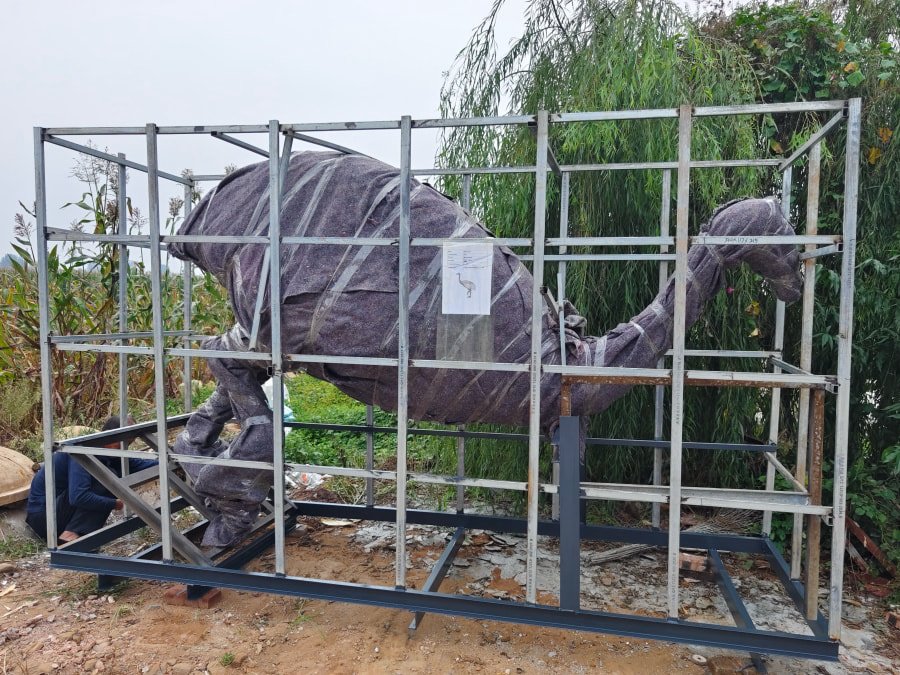
We use iron crates with thick foam padding inside. The iron frame holds the sculpture rigid, and the foam stops it from shifting or scratching during transport. This is stronger than most standard wooden crate packaging you will see from other suppliers.
I want to be honest with you here. We cannot promise zero damage in every single case. Sculpture is heavy cargo. Once it leaves our workshop, it passes through sea freight, port handling, and then inland trucking. Some roads, especially on the final leg of delivery, can be rough. Vibration over a long journey can sometimes cause small chips or cracks3 — this happens more often with LCL (less-than-container-load) shipments, where your sculpture shares a container with other cargo4.
| Shipping Type | Risk Level | Our Packing Approach |
|---|---|---|
| FCL (Full Container) | Low | Iron crate, full foam, internal bracing, secured to container floor |
| LCL (Shared Container) | Moderate | Iron crate + warning labels on all sides, foam reinforced |
For a full container, we pack everything ourselves and seal it. Nobody else touches it until it reaches the destination port. That is why FCL damage rates are very low in our experience. For LCL, we do our best. We put large warning labels on every side of the crate — "FRAGILE," "DO NOT PLACE HEAVY ITEMS ON TOP," "THIS SIDE UP." We mark the weight clearly. But we cannot control how a third-party warehouse team handles mixed cargo. If your sculpture is over 500 kg or if it is a delicate piece with fine details, I always recommend a full container.
One client from Germany once shipped a large angel marble fountain base via LCL to save cost. The fountain arrived with one small corner chipped. It was not a disaster, but it was frustrating. Since then, for anything over a certain size or value, we strongly suggest going FCL.
Many first-time buyers ask me: "Do you have stock in the US?" We do not keep stock overseas. Every piece is made to order. But the good news is that we handle the entire shipping process for you if you need us to.
There are two main options: port-to-port and door-to-door (DDP). Port-to-port is cheaper but requires you to handle customs clearance on your end. Door-to-door means we handle everything — you just wait for your sculpture to arrive.
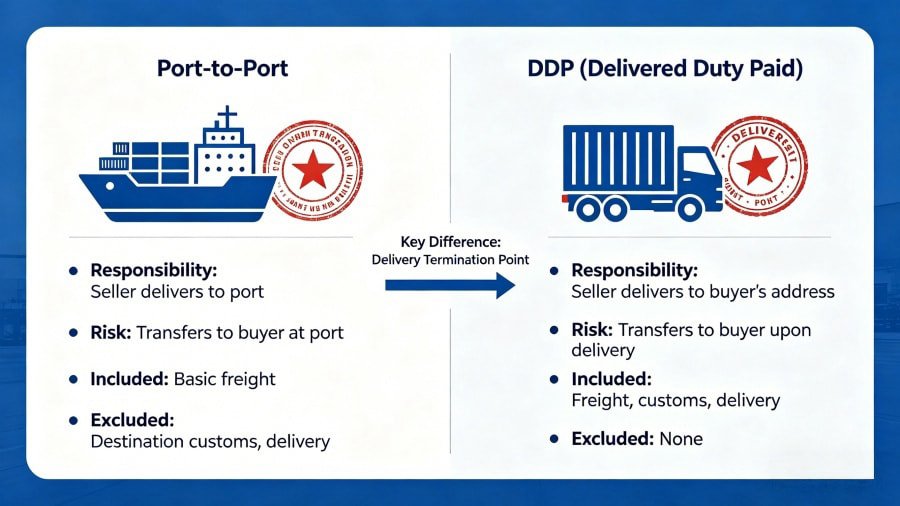
This option works well if you already have a trusted freight forwarder in your country. You pay for sea freight from our port in China to your destination port. Your freight forwarder then handles customs clearance, import duties, and inland delivery. This can save you some money, but you need to know what you are doing. Customs paperwork for stone or metal sculptures has specific HS codes5, and errors can cause delays or unexpected fees.
If you do not have a freight forwarder, we can recommend one. We have long-term partners in Europe and North America who know how to handle sculpture shipments.
This is the option I recommend for most private buyers, villa owners, and smaller galleries. DDP means we handle everything from our workshop to your front gate. Sea freight, customs clearance, import duties, inland delivery — all included.6 You receive your sculpture the same way you receive a large appliance delivery.
| Shipping Option | Who Handles Customs | Best For | Cost Level |
|---|---|---|---|
| Port to Port (FOB/CIF) | You or your freight forwarder | Buyers with existing logistics partners | Lower |
| Door to Door (DDP) | Mily Art handles everything | Private buyers, first-time importers | Higher but worry-free |
One important note about door-to-door delivery: when the truck arrives at your property, someone needs to be ready to unload the crate. Large sculptures — especially marble ones — are extremely heavy. Most delivery trucks are not equipped with a crane or forklift on board.7 You will need a forklift on site, or you can rent one. I always remind clients of this in advance. There is nothing worse than having your sculpture sitting on a truck because nobody arranged for unloading equipment.
Getting the sculpture to your property is only half the job. Installing it correctly matters just as much. A sculpture that looks beautiful but tips over in the first strong wind is dangerous. A sculpture that is bolted down with visible hardware loses its visual impact.
The right installation method depends on your surface type and the size of the sculpture. The goal is always the same: the piece must look natural and beautiful while staying completely stable and secure.
Method 1: Embedded Iron Frame (Pre-installed Base)
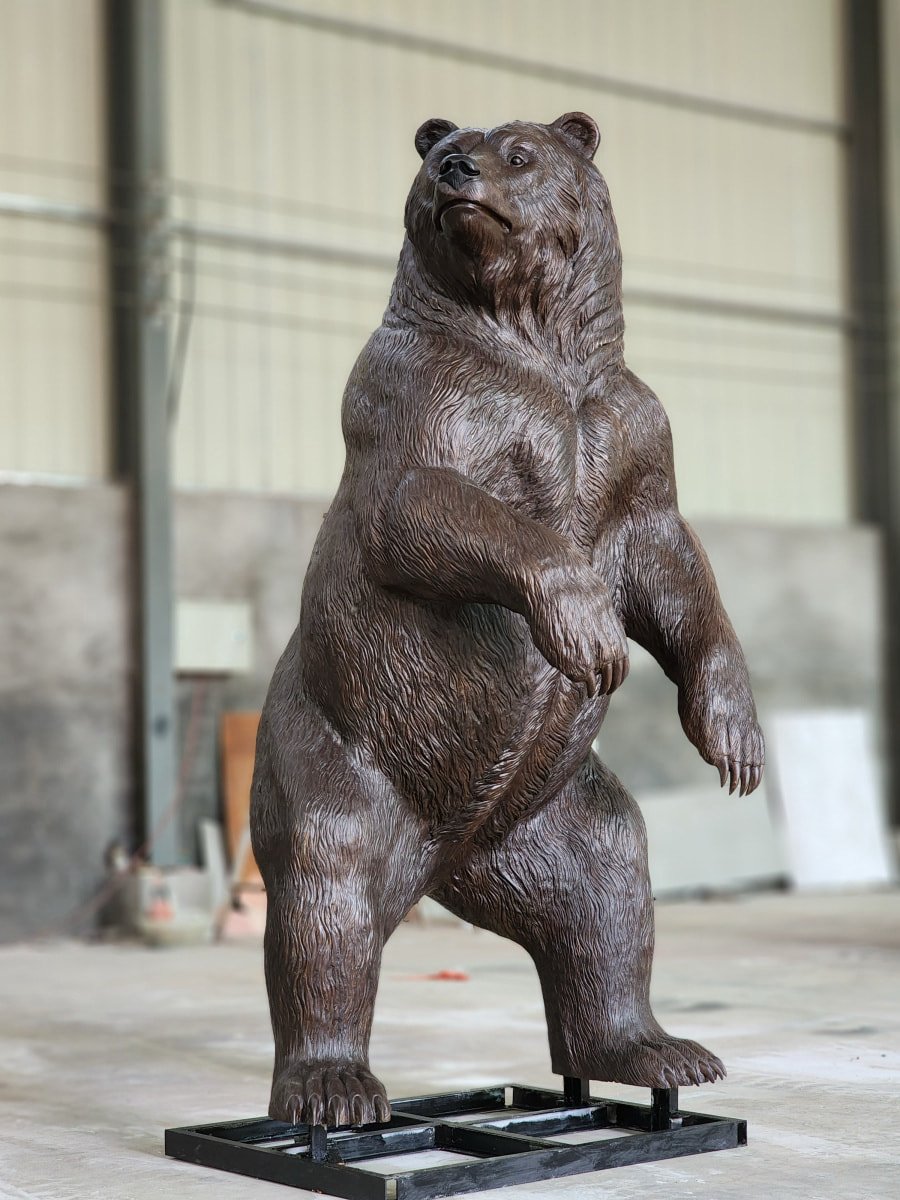
This is the most secure method for large, heavy sculptures placed on a lawn or a new concrete pad. Before you pour the concrete base, we supply iron anchor frames that are embedded directly into the concrete while it is still wet. Once the concrete sets, the sculpture base sits over the frame and is bolted down from inside. The bolts are completely hidden. From the outside, the sculpture appears to simply rest on its base.
This method is ideal for life-size or larger bronze animals, figurative statues, and tall abstract sculptures that need to resist wind loading8. I worked with a client in Texas who was placing a 1.8-meter bronze horse in his estate garden. We sent the anchor frame design drawings two weeks before shipping. His contractor poured the base while we were still finishing the sculpture. By the time it arrived, the base was ready. Installation took half a day.
Method 2: Expansion Screws (Existing Concrete Surface)
If you already have a finished concrete surface — a courtyard, a plaza, or a paved terrace — you do not need to break it up to install a sculpture. We drill anchor holes into the base of the sculpture, and expansion bolts are driven into the concrete. This method is clean, fast, and strong enough for most mid-size sculptures.
| Method | Best Surface | Visibility of Hardware | Strength Level |
|---|---|---|---|
| Embedded Iron Frame | New concrete / lawn | Fully hidden | Very high |
| Expansion Screws | Existing concrete / stone paving | Minimal | High |
| Epoxy / Structural Glue | Flat hard surface | Hidden | Medium |
Method 3: Epoxy or Structural Adhesive
For smaller sculptures — garden figures under 100 kg, decorative pieces on pedestals, or wall-mounted reliefs — a high-strength structural adhesive is often enough9. We use a two-part epoxy that bonds stone or metal to concrete, stone, or tile. It is invisible when dry and holds well in outdoor conditions. This is not suitable for anything tall or heavy, but for decorative garden pieces it works perfectly.
The principle behind all three methods is the same. The sculpture must look like it belongs there — no visible bolts, no clunky hardware, no ugly base plates. And it must be safe. A large bronze bull in a public garden that tips over in a storm is not just damaged property, it is a safety risk. We take the structural side of installation seriously.
Nobody wants to think about this, but it is a fair question and you deserve a straight answer. Damage does happen sometimes, especially with LCL shipments. So here is exactly what we do.
If your sculpture arrives with damage, photograph and video everything immediately before moving the crate. Send that documentation to our sales team the same day. We will start the insurance claim process and give you a resolution plan based on the extent of the damage.
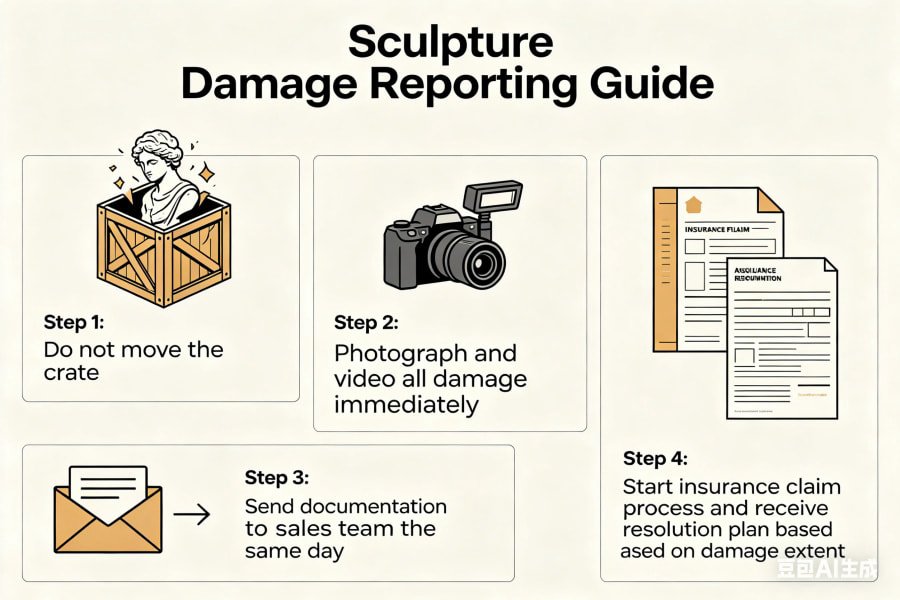
The most important thing is speed and documentation. Do not move the sculpture. Do not open all the packaging and discard it. The packaging itself is evidence. Take photos of the outside of the crate first — any crushed corners, broken boards, or impact marks. Then photograph the sculpture itself from multiple angles. A short video walking around the damage is even better.
Send everything to your sales contact at Mily Art within 24 hours of delivery. This timeline matters for insurance claims. Most cargo insurance policies require notification within a very short window after delivery.10
Once we receive your documentation, we do a full review. We look at the damage photos, cross-reference with our pre-shipment photos and videos (which we always take before packing), and contact the logistics provider. Then we come back to you with a solution.
| Damage Level | Likely Resolution |
|---|---|
| Minor chip or scratch | Partial refund or on-site repair guidance |
| Significant structural damage | Replacement piece manufactured and reshipped |
| Total loss | Full refund or full replacement, subject to insurance process |
We do not make clients fight for resolutions. If a piece arrives clearly damaged through no fault of the client, we fix it. That might mean sending a replacement, issuing a refund, or in some cases sending repair materials and guidance for a local stonemason to fix a minor chip. We decide together with the client what makes the most sense given the timeline and the scale of the damage.
All our international shipments are covered by cargo insurance.11 For high-value pieces — anything over a certain declared value — we always recommend full-value coverage, not just basic carrier liability. We can help arrange this before shipment.
Shipping a large sculpture internationally is manageable. With good crating, the right shipping method, a clear installation plan, and a supplier who handles problems honestly, the whole process is much simpler than it looks.
"Importing personal and commercial original works of art", https://www.help.cbp.gov/s/article/Article-1146. Independent guidance on importing oversized or heavy art objects can support the statement that purchasing and importing a large sculpture involves logistics such as packing, freight transport, customs procedures, and installation planning, even though the exact process varies by shipment terms and destination country. Evidence role: general_support; source type: government. Supports: Buying a large sculpture from China sounds complicated. Shipping, customs, crating, installation — most buyers freeze before they even start.. Scope note: The article’s broader reassurance that the process is 'more straightforward than most buyers think' is evaluative and would not be directly proven by neutral sources; external evidence can mainly substantiate the typical process components involved. ↩
"Basic Importing and Exporting | U.S. Customs and Border Protection", https://www.cbp.gov/trade/basic-import-export. Trade-facilitation resources can provide contextual support that international import procedures follow standardized logistics, customs, and delivery steps, which may make the process manageable for buyers; however, such sources would not directly prove the comparative perception claim about what 'most buyers think.' Evidence role: general_support; source type: institution. Supports: Importing a large sculpture from China can be a manageable process when standard shipping and customs procedures are followed.. Scope note: Evidence can support the existence of standard import procedures, but not the subjective comparison to buyer expectations without survey data. ↩
"Effects of Vehicle-Induced Vibrations on the Tensile Performance of ...", https://pmc.ncbi.nlm.nih.gov/articles/PMC6747572/. Transport-packaging and vibration studies show that prolonged vibration and repeated shock during road and sea transit can damage fragile cargo, which supports the mechanism by which brittle materials such as stone may develop chips or cracks in shipment. Evidence role: mechanism; source type: paper. Supports: Long transport vibration can contribute to small chips or cracks in heavy brittle sculptures.. Scope note: Most studies address fragile goods or packaged products generally rather than sculptures specifically. ↩
"Less than container load - Wikipedia", https://en.wikipedia.org/?title=Less_than_container_load&redirect=no. Industry and customs references define less-than-container-load (LCL) as a shipment in which cargo from multiple shippers is consolidated in one container, which supports the description that the sculpture shares container space with other goods. Evidence role: definition; source type: government. Supports: LCL (less-than-container-load) shipments are shared-container shipments in which a sculpture travels with other cargo.. ↩
"[PDF] Harmonized Tariff Schedule of the United States Revision 6 (2026)", https://hts.usitc.gov/reststop/file?release=currentRelease&filename=Chapter%2071. Customs tariff schedules classify original sculptures and statuary under specific Harmonized System headings, supporting the statement that imported stone or metal sculptures are associated with designated HS codes for customs documentation. Evidence role: definition; source type: government. Supports: Stone or metal sculptures are assigned specific HS codes in customs paperwork.. Scope note: The exact code can vary with material, originality, and product category, so a tariff schedule should be matched to the item actually imported. ↩
"DDP - Wikipedia", https://en.wikipedia.org/wiki/DDP. The ICC Incoterms definition of Delivered Duty Paid (DDP) supports the core point that the seller bears responsibility for delivery to the named destination and for import clearance and duties, although the exact scope of services such as unloading or final placement depends on the sales contract. Evidence role: definition; source type: institution. Supports: Under DDP, the seller handles delivery to the named destination including import clearance and duties.. Scope note: Incoterms define risk and cost allocation, but practical service details beyond the named place of delivery may vary by contract. ↩
"Trucking Industry - Loading and Unloading - OSHA", http://www.osha.gov/trucking-industry/loading-unloading. Freight delivery guidance for heavy goods commonly distinguishes standard curbside truck delivery from specialized liftgate, crane, or forklift services, supporting the point that unloading equipment is often not included by default. Evidence role: general_support; source type: government. Supports: Most standard delivery trucks for freight are not equipped with onboard crane or forklift unloading equipment.. Scope note: The frequency of onboard equipment varies by carrier and service level, so sources may support common practice rather than a universal rule. ↩
"[PDF] The 2018 International Building Code®: A Compilation of Wind ...", https://www.fema.gov/sites/default/files/2020-07/2018-ibc-compliation-wind-resistant-provisions.pdf. Structural engineering and building-code resources treat wind load as a design force that must be considered for freestanding outdoor structures and attachments, which supports the relevance of wind resistance in installing tall sculptures outdoors. Evidence role: mechanism; source type: government. Supports: Tall outdoor sculptures should be installed with consideration for wind loading.. Scope note: Building-code sources address structures broadly and do not provide sculpture-specific installation prescriptions without project-specific engineering. ↩
"[PDF] Best Practices in Stone Building Preservation Management", https://home.nps.gov/saan/learn/upload/FinalBestPracticesInStoneBuildingPreservationManagement-2.pdf. Engineering and conservation literature on structural adhesives can support the limited claim that certain two-part epoxies develop strong bonds to stone, concrete, or metal in suitable conditions; however, adequacy for a given sculpture depends on substrate, load, exposure, and safety factors rather than adhesive strength alone. Evidence role: mechanism; source type: paper. Supports: For some smaller sculptures, structural adhesive can provide adequate bonding to hard surfaces.. Scope note: A neutral source can support material properties, but not confirm that adhesive alone is sufficient for every installation scenario described. ↩
"Freight damage claims FAQs - GSA", https://www.gsa.gov/policy-regulations/policy/transportation-management-policy/freight-damage-claims-faqs. Marine cargo claims guidance from insurers and trade bodies commonly requires prompt notice of visible loss or damage shortly after delivery, supporting the statement that claims timelines are often short even though the exact reporting window varies by policy and jurisdiction. Evidence role: general_support; source type: institution. Supports: Cargo insurance claims often require very prompt notification after delivery.. Scope note: The required notice period is policy-specific, so a source may establish common practice rather than a single universal deadline. ↩
"Insurance for Shipping Artwork | Anthony Wakefield & Co", https://www.anthonywakefield.com/2025/05/21/insurance-for-shipping-artwork/. A citation should point to the seller's published policy or contract terms stating that international shipments include cargo insurance, because this is a company-specific factual claim rather than a general industry principle. Evidence role: case_reference; source type: other. Supports: The company covers all international shipments with cargo insurance.. Scope note: Neutral external sources cannot independently verify a seller's internal shipping policy unless the company has publicly documented terms. ↩

 We only use the information provided above to contact you in relation to your inquiry. For further details, read our Privacy Policy.