
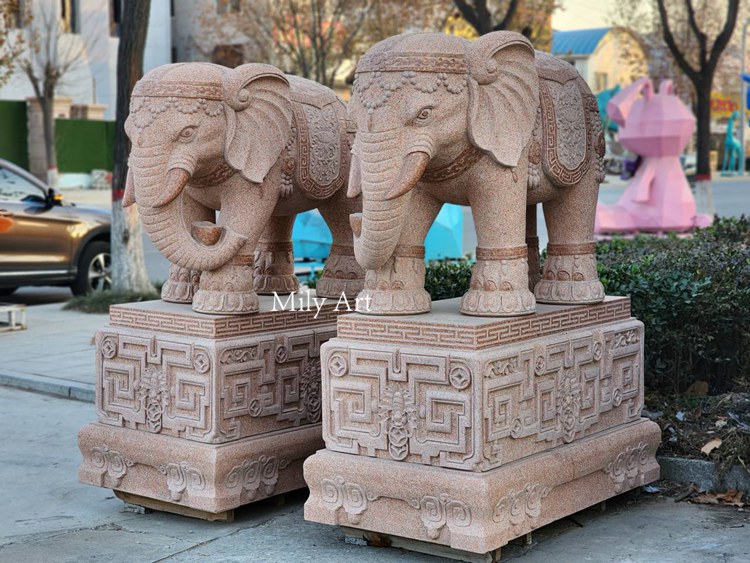
For an elephant statue near your entrance, choose a position that suits the doorway, leaves a clear walking route and expresses the meaning you prefer. Facing inward can be used as a decorative gesture of welcome; facing outward can suggest a guardian looking toward the approach. Neither orientation has a universal, verifiable rule that guarantees good luck.
Elephants carry different meanings across cultures and modern decorative traditions. This guide separates popular symbolic interpretations from practical placement advice, so you can choose a setting without treating a custom as a promise of wealth, protection or success.
| Position | Possible decorative reading | Practical placement |
|---|---|---|
| Facing inward | Welcome, arrival or gathering into the home | Place beside the foyer rather than in the door swing or walking line. |
| Facing outward | A guardian watching the approach | Set back from the threshold; avoid projecting trunks at shoulder or head height. |
| A matched pair | Balance and symmetry at an entrance | Measure both sides and keep the clear opening wide enough for daily use. |
| Facing a garden path or seating area | A focal point within the landscape | Consider the main viewing angle, planting and sightlines. |
There is no single compass direction that applies to every elephant sculpture. If you follow a particular religious practice or school of feng shui, use advice specific to that tradition rather than mixing rules from unrelated sources.
OUTSIDE
Doorway · clear walking route
↓
Statue beside the entrance, looking into the room
INSIDE
OUTSIDE
Doorway · clear walking route
↑
Statue beside the entrance, looking toward the approach
INSIDE
Illustrative layouts, not prescribed feng-shui rules. The arrows show facing direction; the sculpture should remain beside the walking route.
| Setting | What to measure | What to avoid |
|---|---|---|
| Entrance or foyer | Door swing, clear passage, plinth size and viewing height | Blocking access or crowding a narrow threshold. |
| Living room | Shelf or table load capacity and distance from the edge | A heavy sculpture on an unstable or undersized surface. |
| Study or home office | Desk space, sightline and secure support | Sharp projections in the working area. |
| Garden or patio | Foundation, drainage, weather exposure and access for delivery | Soft ground, ponding water or a base that can settle unevenly. |
| Hotel or public entrance | Pedestrian flow, accessible routes, maintenance and anchoring | Assuming a decorative base is an engineered foundation. |
A tabletop piece and a life-size stone elephant require different planning. For a large sculpture, obtain its finished dimensions, approximate weight, base footprint and lifting requirements before preparing the site. Coordinate anchoring and the foundation with the installer.
In popular contemporary decoration, an upward trunk is often associated with celebration or good fortune, while a lowered trunk may be read as calmness or grounded strength. These interpretations vary; neither pose is inherently unlucky, and a naturalistic elephant may simply be shown in a normal animal posture.
| Pose | Design consideration | Useful for |
|---|---|---|
| Trunk raised | Creates a taller silhouette and may project beyond the base | A lively focal point where overhead and side clearance are available. |
| Trunk lowered | Creates a quieter outline; check the trunk’s distance from the ground | A calm composition or lower visual profile. |
| A family or pair | Needs room for several bases and a clear group arrangement | A wider garden or entrance setting where the whole group can be seen. |
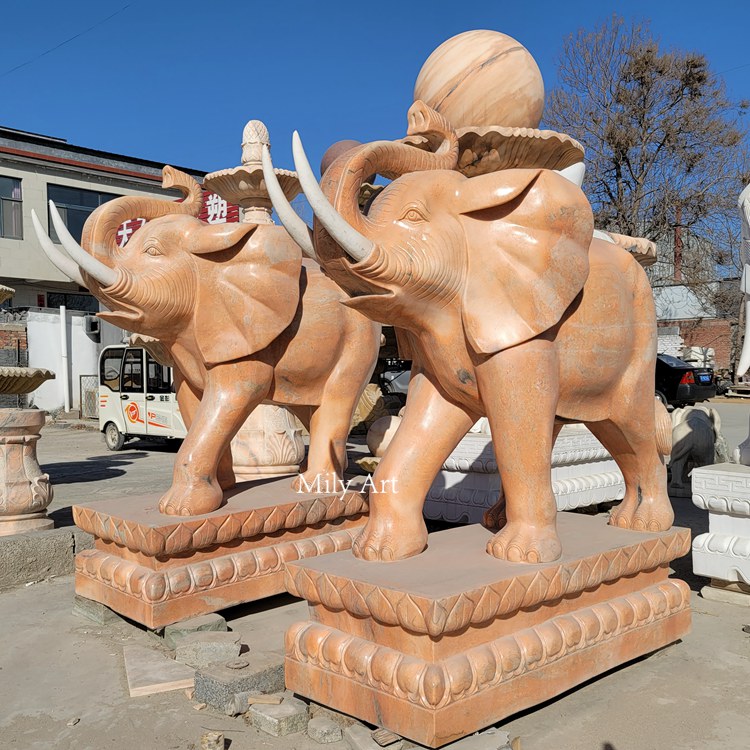
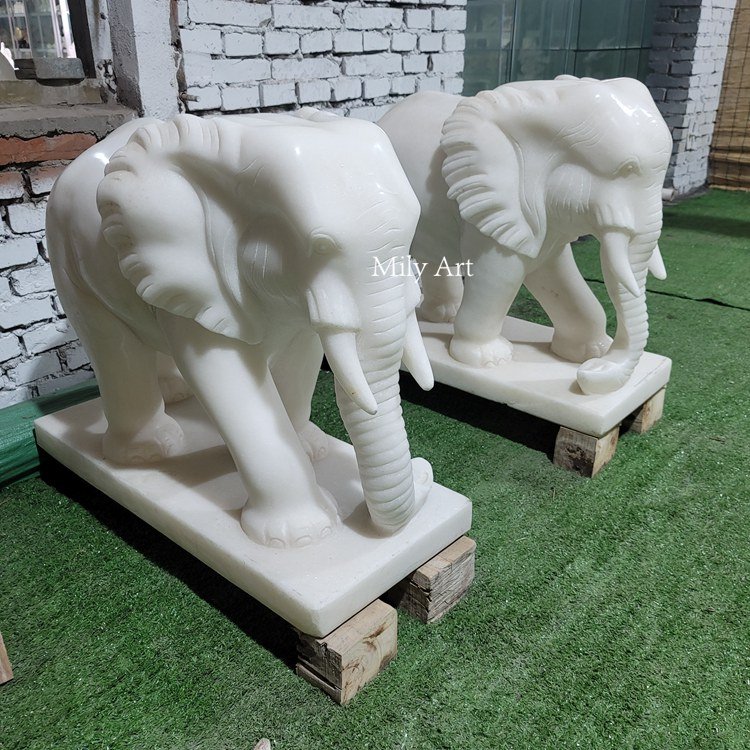
Choose the material together with the sculpture’s size, surface finish and local environment. Marble provides natural veining and a carved stone appearance; bronze offers a cast surface with a chosen patina. Both require a suitable base, drainage and a maintenance plan. Ask the supplier to explain how the proposed material and finish suit your climate.
For a large work, confirm packing, delivery access and unloading before purchase. A shipping quotation does not automatically include a crane, foundation or installation.
There is no universal direction with a proven effect on luck. Inward and outward arrangements can express different decorative intentions. Choose a tradition-specific interpretation if that matters to you, while keeping the entrance usable.
No universal rule supports that claim. Popular interpretations differ, and many naturalistic sculptures use a lowered trunk for the pose and composition.
Yes. A single sculpture can work as a focal point. A pair suits a symmetrical layout, but it needs sufficient space on both sides of the entrance.
That depends on the particular symbolic system you follow; it is not a general installation requirement. For a large work, stable support, access and drainage remain essential in any orientation.
Compare our marble elephant collection, life-size marble elephant design and bronze elephant design. Send site photographs, available width and depth, preferred pose and delivery postcode for a project quotation.
 We only use the information provided above to contact you in relation to your inquiry. For further details, read our Privacy Policy.